
Email lists are the foundation for an effective email marketing campaign. Building an email list is ongoing for as long as you need it to....

Key Takeaways
Your email team spends hours every week segmenting lists, writing subject line variations, picking send times, and digging through performance reports. And after all that work, open rates still stall out, and engagement stays inconsistent.
AI changes how that work gets done. It does not replace human strategy, but it takes over the repetitive analysis and execution that eats up time without really needing creative input. Instead of manually A/B testing 10 subject lines, AI can generate and test hundreds at once. Instead of guessing when to send, it looks at individual behavior and delivers emails when each person is most likely to open.
More and more email platforms are building AI directly into everyday workflows, so teams can use these capabilities without needing data science skills. The shift is away from manual execution (writing every variation, choosing every segment, and deciding every send time) and toward strategic oversight. Marketers focus on goals, messaging, and brand voice, while AI handles optimization and personalization at scale.
This guide explains how AI functions in real email marketing scenarios, which tools apply it most effectively, where it delivers the biggest gains, and what limitations you should understand before relying on AI for email marketing.
AI in email marketing operates through two primary mechanisms: analyzing past behavior to predict future actions, and generating content variations based on patterns learned from successful campaigns.
AI analyzes how recipients interact with emails, including opens, clicks, purchases, and unsubscribes, to identify patterns that predict future behavior. When trained on thousands or millions of interactions, machine learning models recognize that certain subject line structures, content types, or send times correlate with higher engagement for specific audience segments.
These models continuously improve as they process more data. Each campaign generates new signals (who opened, who clicked, who bought) that refine predictions for the next send. Over time, the system learns which factors most strongly influence engagement for your specific audience.
Predictive AI uses historical data to forecast outcomes and make decisions. In email marketing, this means:
Generative AI creates new content based on patterns learned from existing examples. In email contexts, this includes:
Both types work together: predictive AI decides who should receive an email and when, while generative AI helps create what that email should say.
AI models are only as good as the data they’re trained on. If your engagement data includes high bounce rates, spam complaints, or sends to invalid addresses, the AI learns from distorted signals. It might optimize send times based on when bounces occur or create segments that include inactive addresses that will never engage.
Maintaining clean email lists ensures AI models train on real recipient behavior rather than system errors. Tools like DeBounce remove invalid, risky, and inactive addresses before they distort engagement data, helping AI make accurate predictions based on genuine user interactions.
In email marketing, AI usually appears as part of broader platforms or as specialized tools that integrate with existing systems.
Major email marketing platforms now build AI directly into core workflows, handling automation, personalization, and optimization without requiring separate tools.
These platforms handle end-to-end campaign management, with AI optimizing each step automatically based on your historical campaign data.
Specialized tools focus specifically on generating or refining email copy using generative AI trained on successful marketing content.
These tools help marketers move faster by speeding up content creation and offering data-backed variations to test. But they require human oversight to ensure everything stays on-brand and that the message actually makes sense in context.
AI-powered analytics platforms help marketers understand campaign performance and make strategic decisions based on behavioral insights.
Maintaining high-quality engagement data is critical for these analytics tools to generate accurate insights. Email list monitoring ensures ongoing list health by automatically identifying and flagging invalid or risky addresses, so AI analytics tools can base predictions on real user behavior.
AI delivers practical value across specific email marketing tasks that previously required significant manual effort.
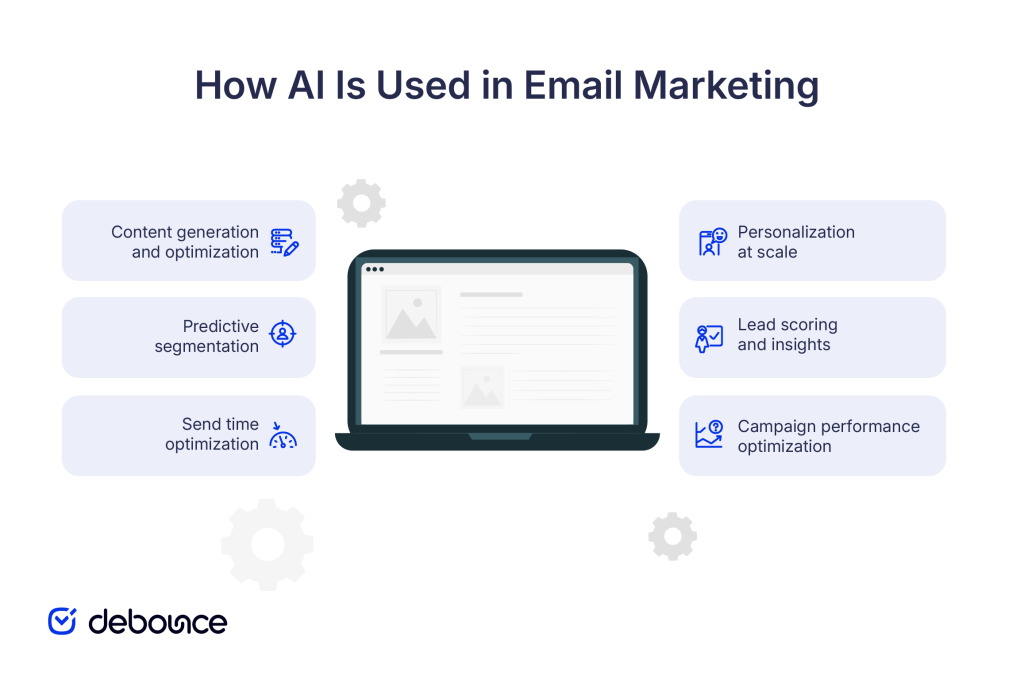
AI writes subject line variations, email body copy, and calls-to-action based on successful patterns from past campaigns. Instead of manually writing 5-10 subject line options, marketers provide campaign context, and AI generates dozens of variations aligned with brand voice and optimized for engagement. Marketers review, refine, and select the best options rather than creating from scratch. Learning how to use AI to improve emails accelerates this process.
Rather than creating static segments based on demographics or basic behavior, AI builds dynamic segments that update continuously based on real-time engagement signals. The system identifies micro-segments (groups of subscribers with similar behavior patterns) and automatically routes appropriate content to each group without manual intervention.
AI analyzes when individual subscribers historically open and engage with emails, then schedules delivery for each person’s optimal time rather than sending to everyone simultaneously. This individualized timing can significantly improve open rates compared to batch-sending at a single “best average” time.
AI enables true one-to-one personalization by dynamically inserting content blocks, product recommendations, and messaging variations based on each recipient’s behavior, preferences, and engagement history. What previously required creating separate campaigns for each segment now happens automatically within a single campaign.
AI evaluates email engagement alongside other behavioral signals to assess how likely a lead is to convert. It looks for patterns drawn from past successful conversions rather than relying on isolated actions. This allows sales and marketing teams to focus follow-up efforts on the contacts with the strongest signals of intent.
AI continuously tests variables, such as subject lines, send times, and content variations, and automatically allocates traffic to best-performing options. This real-time optimization means campaigns improve during execution rather than requiring manual A/B testing and subsequent campaign adjustments.
Understanding how to measure the effectiveness of your email marketing campaign helps you evaluate which AI optimizations deliver the strongest results for your specific goals.
AI delivers measurable improvements across efficiency, relevance, and campaign performance.
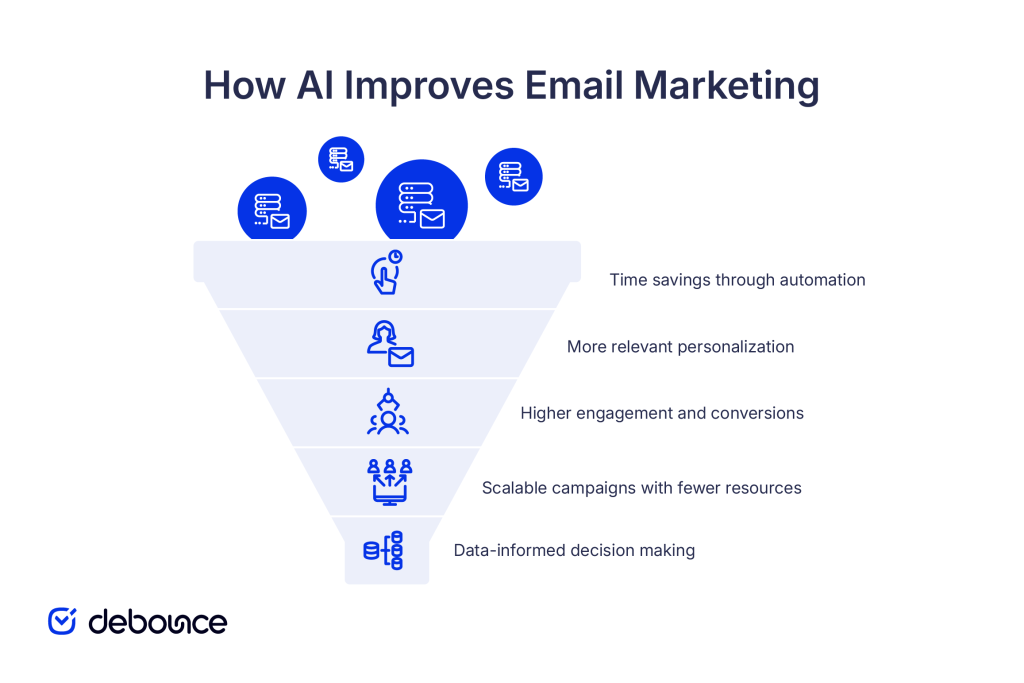
Running better email campaigns with AI optimization helps teams earn from email marketing more effectively by improving returns on every send.
AI offers significant advantages but comes with important limitations that require understanding and management.
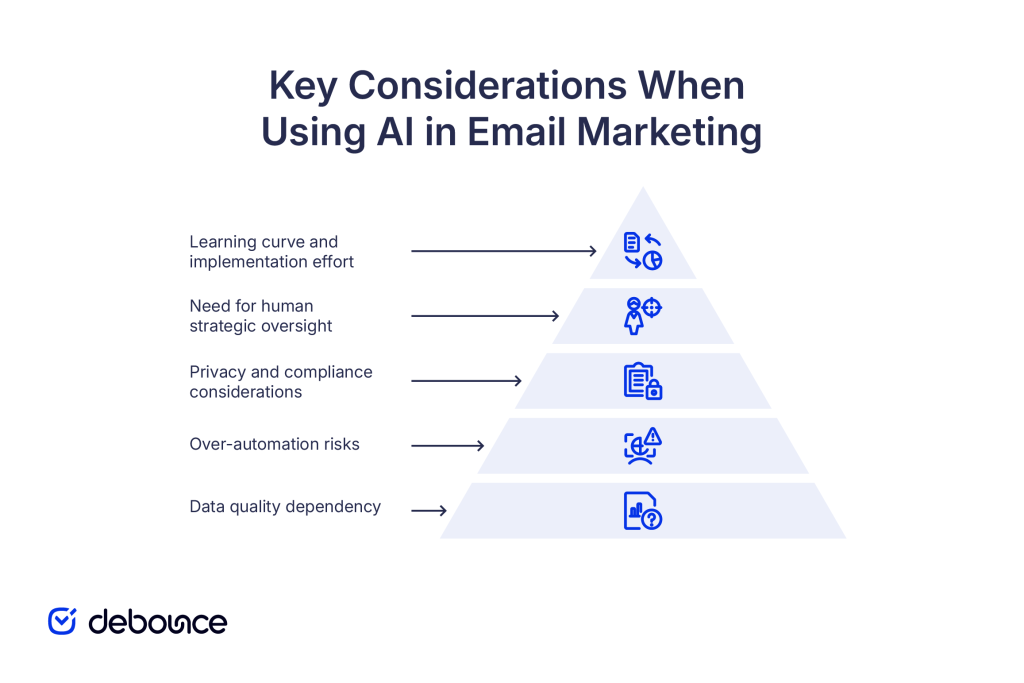
AI models learn from historical data, so if your email lists contain high bounce rates, invalid addresses, or engagement distorted by poor deliverability, the AI trains on bad signals. Garbage in, garbage out applies directly, as AI can’t produce good results from poor-quality data. Regular list cleaning and verification are prerequisites for effective AI implementation.
Relying too heavily on AI without human oversight can lead to:
AI should augment human judgment, not replace it entirely.
AI personalization requires collecting and analyzing significant behavioral data. This raises privacy concerns and regulatory compliance requirements under GDPR, CCPA, and similar frameworks. Ensure your AI tools and data practices comply with applicable privacy regulations and respect subscriber preferences.
AI optimizes toward the goals you set, but it can’t determine what those goals should be. Humans must still:
While AI is a powerful execution tool, strategy remains a human responsibility.
Using AI effectively takes time. Teams need space to train models on their own data, connect tools with existing systems, and learn how to interpret and act on AI-driven insights. Expect an initial investment period before seeing optimal results.
AI for email marketing automates the repetitive analysis, optimization, and personalization tasks that previously consumed marketers’ time, freeing them to focus on strategy, creative development, and campaign planning. Predictive AI determines who should receive emails and when, while generative AI helps create relevant, engaging content at scale.
The most effective approach treats AI as a support system that handles execution optimization while humans maintain control over strategic decisions, brand voice, and campaign goals.
Evaluate your current email marketing timing and segmentation approaches. Identify which repetitive tasks consume the most time and research AI tools that automate those specific workflows within your existing platform or through integration.
Before deploying AI optimization, verify your email lists are clean and engagement data is reliable. Use DeBounce to identify and remove invalid, risky, and inactive addresses that distort AI training data. Start with verified lists that generate accurate engagement signals, then let AI optimize from a foundation of real user behavior rather than bounce-distorted metrics.
How does AI impact the future of email marketing?
AI will make email marketing more personalized and efficient by automating optimization tasks like send-time selection and content personalization, allowing marketers to focus on strategy and creative development rather than manual execution.
Will email marketing be replaced by AI?
No, AI will augment email marketing by handling repetitive optimization and execution tasks, but humans will continue to define strategy, maintain brand voice, set campaign goals, and provide creative direction that AI cannot replicate.
What challenges should marketers anticipate when using AI in email marketing?
Key challenges include ensuring data quality for accurate AI training, maintaining human oversight to prevent over-automation, complying with privacy regulations, and investing time to learn AI tools and interpret their recommendations effectively.
Find quick answers to your questions about our pricing and plans.

Email lists are the foundation for an effective email marketing campaign. Building an email list is ongoing for as long as you need it to....

Emails still remain some of the most effective marketing tools you can use to promote your business or the service it offers. At the same...

If your email campaigns suddenly start bouncing, open rates plummet overnight, or clients report that they never receive your messages, there’s a strong chance your...

Basic demographic information was once the key to driving demand generation. But now that this data is widely accessible, it is no longer sufficient to...


This post is about the 10-point framework of a perfect welcome email to delight your new subscribers. You know the feeling of getting a brand...

Learn which SMTP ports to use for email delivery: 25, 465, 587, or 2525. Our guide helps you choose the right port for security and...
