
Enterprise platforms protect against advanced persistent threats and BEC, privacy providers focus on encryption, and hygiene services prevent delivery failures and list contamination....

Key Takeaways
Email providers like Gmail, Yahoo, and others, can decide whether or not your emails should make it to your recipients’ inboxes based on your sender’s reputation. Simply put, email providers fight spam, and you must make sure that your emails cannot be categorized as spam. Therefore, you should know how to maintain a good sender reputation and avoid some common mistakes.
Experienced marketers know that writing an email with a good call to action is not enough. Beginners often forget how important it is to pay attention to the content of emails so they often create a basic campaign and consider the job done once they’ve hit the send button. The truth is that email marketing is much more complicated, and you should keep in mind many important factors.
For instance, you need high deliverability and low bounce and unsubscribe rates. In this article, we will consider sender reputation in more detail and share some actionable tips on how you can keep a good sender reputation, making sure that your email campaigns are actually effective.
Email sender reputation includes domain and IP reputation. IP reputation is related to the set of IPs that you get from your email service provider. Most of such IPs are shared among numerous accounts, but you can also purchase a private IP. The latter option is usually quite expensive so most marketers use shared IPs. All of these addresses have a certain sender reputation, and email servers analyze this reputation to decide whether or not emails from these addresses can be trusted.
IP reputation is so important for email servers that as much as 83% of failed email deliveries are a direct result of poor reputation. It’s also important to keep in mind that you cannot build a good sender reputation overnight. It can take years to build a great IP reputation, and it can also be ruined with a single bad campaign. Besides, your sender reputation depends on your domain reputation. Even if you have a great IP from one of the best service providers, it won’t help you if your domain reputation is bad.
Domains with a bad reputation are known for sending suspicious emails so you should avoid them. Your domain reputation can undermine the success of your campaigns even if you have a good sending history. For instance, you should keep it in mind when working with free Gmail or Yahoo accounts because they are used to send spam very often. The more emails you send, the more careful you should be.
You should also keep in mind that your IP and domain reputation is directly related to your content reputation. Some types of content act as triggers for email service providers that use content filters. Attachments that look like viruses and text that looks similar to spam messages will damage your content reputation and therefore hurt your deliverability rates.
Sender reputation is calculated using multiple behavioral and technical signals. Email providers evaluate patterns over time, which means consistency and data quality are critical.
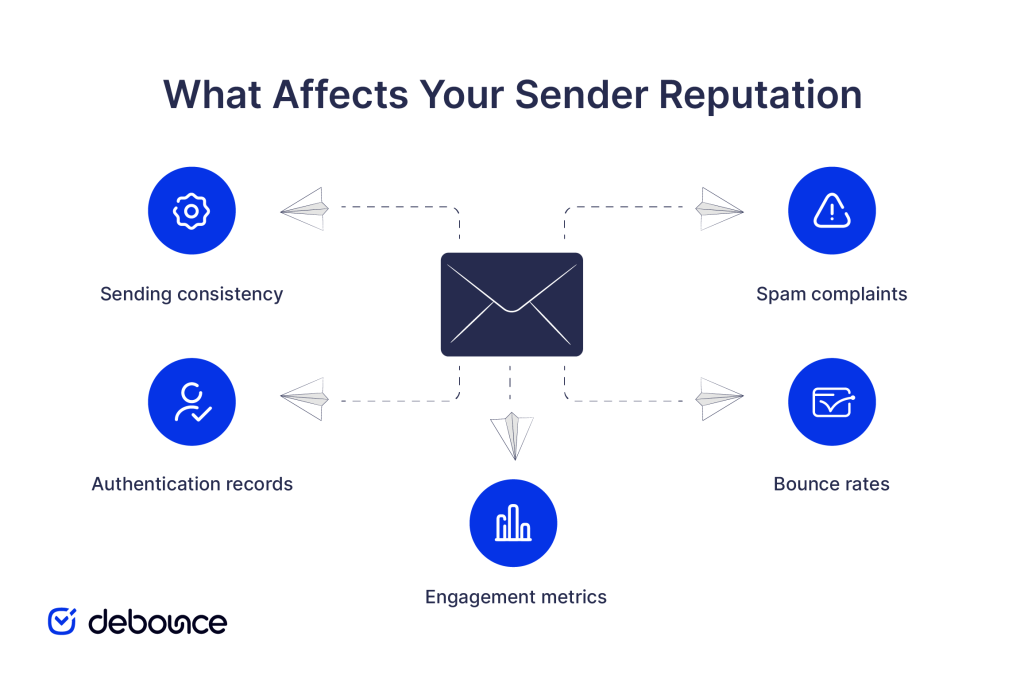
Spam complaints occur when recipients mark your email as spam. These reports are tracked by inbox providers and tied directly to your domain and IP.
Most providers consider complaint rates below 0.1 percent acceptable. Rates approaching or exceeding 0.3 percent are considered risky and can trigger filtering or throttling.
Even small increases in complaint rates can lower your reputation score because they signal dissatisfaction or lack of consent. High complaint volume suggests your content is irrelevant, your list was not permission-based, or your sending frequency is excessive.
Bounces happen when emails cannot be delivered. Hard bounces indicate permanent failures, such as invalid or non-existent addresses, while soft bounces reflect temporary issues, such as a full inbox or server problem.
High hard bounce rates signal poor list quality. Internet service providers interpret repeated delivery failures as evidence that a sender is using outdated, purchased, or scraped lists. Persistent bounce issues damage sender credibility and may result in blocking.
Maintaining a low bounce rate demonstrates responsible list management and strengthens trust with mailbox providers.
Engagement includes opens, clicks, replies, deletions without reading, and spam markings. Positive engagement signals indicate that recipients value your emails. When users consistently open and interact with your messages, providers view your domain as trustworthy.
Low engagement, combined with high delete rates or ignored messages, weakens inbox placement over time. Providers use engagement patterns to determine whether your emails should be prioritized, filtered, or routed to spam folders.
Email authentication verifies your identity as a legitimate sender:
-SPF confirms which servers are authorized to send on behalf of your domain.
-DKIM adds a cryptographic signature to validate message integrity.
-DMARC builds on SPF and DKIM to enforce authentication policies.
Proper configuration prevents spoofing and domain abuse, while missing or misconfigured records create distrust and increase the likelihood of filtering or rejection. Strong authentication supports both security and reputation stability.
Inbox providers monitor sending volume patterns over time. Predictable, steady sending volume builds trust. On the other hand, sudden spikes in activity, such as sending ten times your normal volume, raise red flags and may trigger throttling or temporary blocks.
Consistent cadence demonstrates controlled and legitimate activity. Long-term stability reduces risk and supports healthy reputation development.
Regular monitoring allows you to detect issues before they escalate. Reputation damage often develops gradually, so proactive checks prevent sudden deliverability drops.
Sender score tools evaluate factors such as bounce rates, complaint volume, spam trap hits, blacklist status, and overall sending patterns. These tools generate a reputation score that reflects perceived trustworthiness. Higher scores indicate strong performance, while declining scores suggest potential risk.
When reviewing results, look for trends rather than isolated fluctuations. A steady decline may signal growing list hygiene issues or engagement problems.
Many internet service providers offer feedback loops that notify senders when recipients mark messages as spam. Complaint data collected through feedback loops should be used immediately to remove affected addresses from future campaigns. Continuing to email users who filed complaints significantly harms reputation.
Feedback reports also provide insight into subscriber satisfaction and help refine targeting, content strategy, and frequency management.
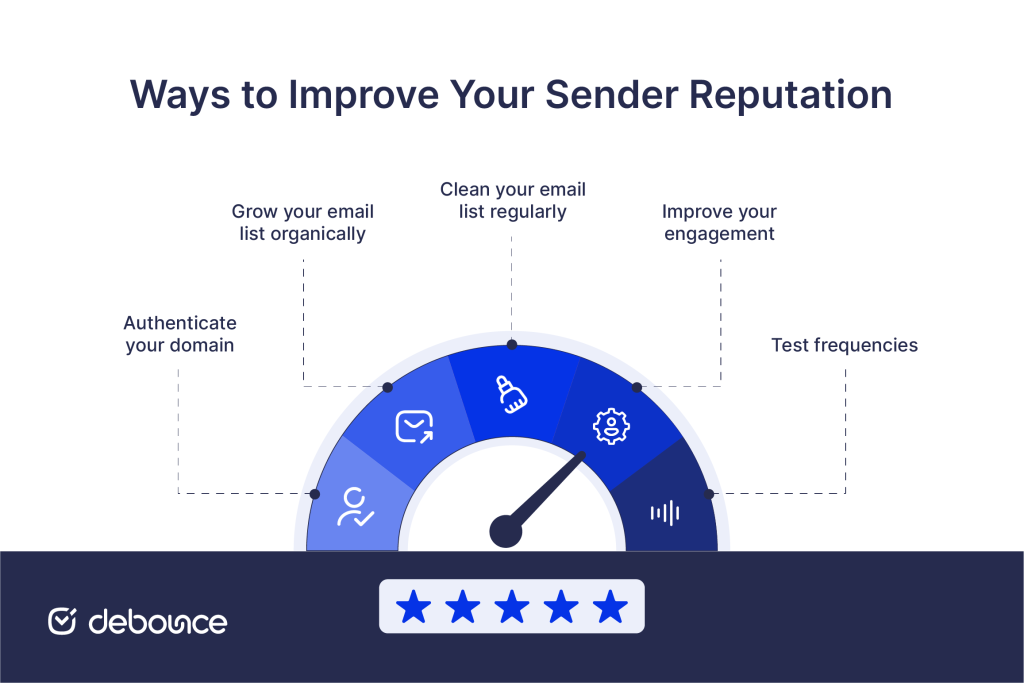
Improving sender reputation requires disciplined practices across authentication, list management, engagement strategy, and sending behavior. Trust builds gradually and depends on consistent, responsible actions.
You can help email servers understand that you can be trusted by letting them know who you are. To do it, add authentication to your accounts. For example, you can use such standard authentications as DKIM, SPF, and DMARC. If your deliverability rates are low, ensuring proper authentication is one of the most important things you should do.
Your bounce and unsubscribe rates, as well as spam reports, have a direct impact on your sender’s reputation. The good news is that you can address all of these problems by growing your email list organically. Your subscribers should subscribe to your emails intentionally, and they should always be aware of the fact that you add them to your email list. We recommend that you always use double opt-in so that every subscriber will confirm their subscription.
Not only should you make sure that all recipients from your list actually want to be there, but you should also make sure that your list only contains active users. Email accounts, especially business accounts, often get deactivated. People change email providers and addresses all the time, and they usually don’t bother to unsubscribe from all the newsletters they’ve subscribed to. Besides, some users can simply stop opening your emails. As a result, such accounts can damage your open rates and increase your bounce rates. The best solution is to separate the main group of subscribers from inactive accounts. You can send re-engagement drip campaigns to inactive subscribers, but if you don’t win them back, the best solution is to remove them from your list. There is also a lot of software that enables you to remove inactive subscribers automatically.
First, you should pay attention to your subject lines and test different subject lines to choose the most effective ones. Make sure that your subject lines don’t contain words and phrases that are associated with spam emails, such as “free,” “discount,” “% off,” “buy now,” “you won,” etc. You may need to read an article about how to test subject lines. You should also make sure that your content is engaging and relevant. Relevance is one of Google’s main priorities. For example, when someone googles “write my research paper for me”, Google displays dissertation writing services and similar websites. If your emails are not relevant, you will have low open rates and high unsubscribe rates. Keep your emails concise and test different calls to action.
Don’t send your emails too often, and make sure to send them consistently. For example, if you send a weekly newsletter, send it on the same day of the week, and try to do it at the same time, as well. Too frequent emails are the main reason why people unsubscribe, so the best approach is to let subscribers choose how often they want to hear from you.
Even well-intentioned campaigns can cause long-term harm when basic safeguards are ignored. Avoiding the following mistakes is essential to maintaining stable deliverability.
Never purchase email lists on the internet. First, these low-quality contacts won’t help you achieve your business goals. Secondly, email lists that are sold online often contain spam traps — addresses that will make your email address blacklisted if you send something to them. Lastly, purchasing email lists violates the CAN-SPAM act, meaning you may pay $16,000 in fines for each email sent this way.
To err is human; when people give you their email addresses, they may make typos. If you send your emails to misspelled addresses, they will result in hard bounces, which in turn can cause serious damage to your sender’s reputation. Use double opt-ins, and you may also use real-time email verification before you add addresses to your list.
Spam traps are very dangerous because they can make your address blacklisted in no time. There are two types of traps: pristine traps and recycled spam traps. Pristine traps are addresses created by blacklist operators and email service providers. They may get collected from the internet as data and end up in your list. Therefore, it’s especially important to growing your list organically. Recycled spam traps are addresses that used to be active but then got deactivated. Many months later, email providers reactivate these addresses and use them as traps — if you send emails to these addresses, you will get blacklisted. This is the main reason why you should keep your email list clean and remove inactive subscribers.
Don’t make your emails too sales-focused. The quality of your content has a direct impact on the success of your emails. Make sure that they actually deliver value and are interesting to read. Make your emails mobile-responsive and format them properly for better readability. Test all of your links and CTAs.
Your email sender reputation determines whether your campaigns reach their audience or disappear into spam folders. It reflects how responsibly you manage data, how consistently you send, and how recipients respond to your content.
One of the most effective ways to protect your reputation is to maintain a clean, validated email list. Removing invalid, disposable, spam-trap, and inactive addresses reduces bounce rates and lowers complaint risk.
DeBounce helps businesses verify and clean email lists before campaigns are sent. By identifying risky addresses in advance, you protect your sender credibility, improve inbox placement, and ensure your emails reach real, engaged recipients.
Sender reputation cannot be instantly reset. If it declines significantly, rebuilding trust requires time and consistent corrective action. This includes cleaning your list, reducing sending volume temporarily, improving engagement, and maintaining proper authentication. Gradual, disciplined sending practices restore credibility over weeks or months.
Yes, if transactional and marketing emails share the same domain or IP, their performance influences overall reputation. Poor engagement or high complaints from marketing campaigns can affect the deliverability of transactional messages. Many organizations separate transactional and marketing traffic to protect critical communications such as receipts, password resets, and confirmations.

Find quick answers to your questions about our pricing and plans.

Enterprise platforms protect against advanced persistent threats and BEC, privacy providers focus on encryption, and hygiene services prevent delivery failures and list contamination....
Keep total bounce rates under 2% for a healthy sender reputation; anything above 5% indicates serious list quality issues. B2B and SaaS typically...

Client-side JavaScript, whether HTML5 attributes, regex, or libraries, can only confirm email format. It cannot verify that a mailbox exists or that an...
Fake emails rely on urgency, impersonation, and visual tricks. Learning the signs lets you slow down and evaluate before acting. Sender domain mismatches,...
If you have ever applied for a loan, you may have found banks poring over your credit history and paying special attention to your credit...


An email subject line tester scores length, wording, sentiment, and spam risk before you send — so you catch weak lines early. Aim...
