
How often do you interact with your email box? I bet pretty often. Whether you receive a critical business email, write a business partner, or...

Key Takeaways
An email lands in your inbox from your IT department. It asks you to verify your login credentials through a link. The sender address looks correct, and the formatting feels familiar. Nothing seems out of place. You click the link, type in your password, and unknowingly hand it straight to an attacker who built a fake login page to mirror your company’s system.
That situation combines two separate threats working together: one made the message look legitimate, the other used that legitimacy to steal your credentials. Spoofing vs. phishing is one of cybersecurity’s most commonly confused distinctions. People often use the terms interchangeably, but they describe different things: one is a method, the other is a goal. Knowing which is which helps you apply the right defenses, recognize the right warning signs, and understand why attacks succeed even against technically aware targets.
Spoofing is the act of faking a technical identifier, such as an email sender address, domain name, website, caller ID, or IP address, to impersonate a trusted source.
In email contexts, spoofing manipulates the technical fields that control how sender information displays to recipients. Attackers forge the “From” address to show a trusted name and domain, register lookalike domains that pass casual visual inspection, or manipulate email headers so messages appear to originate from legitimate servers they don’t control.
Spoofing is primarily a technical attack. It manipulates systems and protocols so that a message, device, or website appears to come from a trusted source. While many attacks ultimately target people, spoofing itself works by exploiting weaknesses in how technology verifies identity.
It is also not limited to direct fraud. In many cases, the immediate objective is not credential theft or financial gain but reconnaissance, testing defenses, or preparing for a larger attack.
Primary spoofing types relevant to email:
Phishing is a goal-driven social engineering attack that sends fraudulent messages to manipulate recipients into taking harmful actions, such as clicking malicious links, downloading malware, submitting credentials, or transferring funds. The name reflects the concept: casting a wide net and waiting for victims to take the bait.
Over 38 million phishing attacks were detected worldwide in 2024 alone, making up a quarter of all cybersecurity incidents detected that year. Phishing targets human psychology, exploiting instincts like trust, urgency, fear, and authority to override critical thinking and prompt immediate action before recipients pause to verify.
The defining characteristic of phishing is intent. Every phishing attack has a specific objective: harvest login credentials, deliver ransomware, divert a payment, steal personal data, or gain initial access to an organizational network. The message, channel, and deception technique are all in service of that objective.
Common phishing channels:
Spoofing and phishing are related but distinct. Understanding their differences across multiple dimensions clarifies both how attacks work and which defenses apply to each.
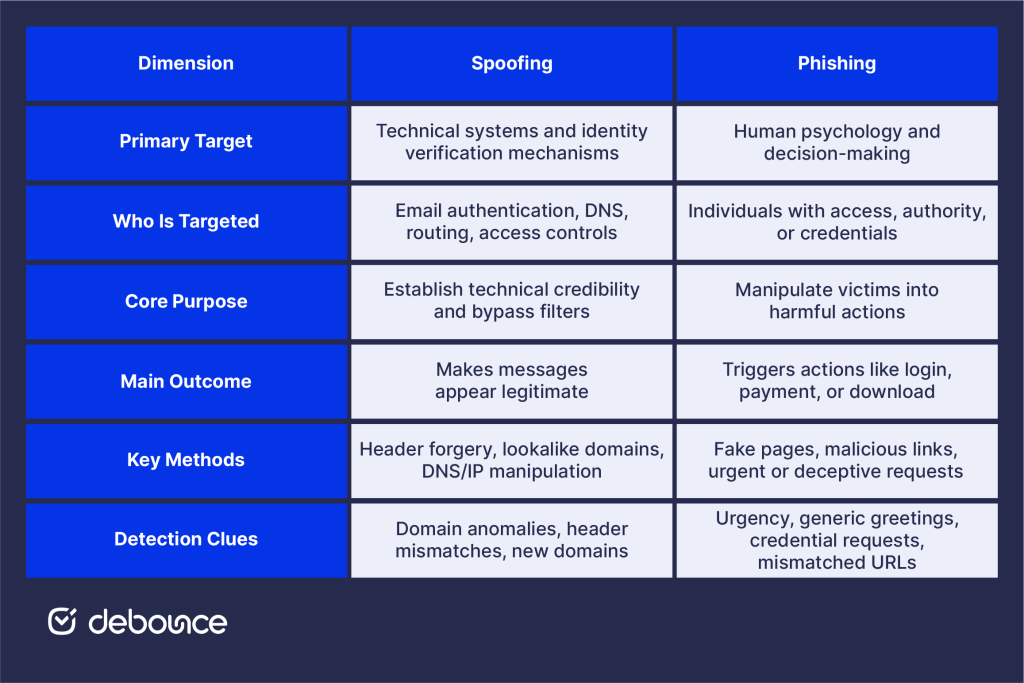
Spoofing targets systems and protocols first, humans second. The initial target is technical: email filters checking sender legitimacy, DNS systems translating domain names, and authentication systems verifying identities. By defeating these technical checks, spoofing creates the conditions for human-level deception.
Common spoofing targets include:
Phishing targets human psychology directly. The goal is to trigger a specific response from a specific type of person. Target selection reflects access and authority:
Spoofing’s purpose is to establish credibility and bypass filters, creating the conditions that make a subsequent attack more effective. Spoofed messages reach inboxes that would otherwise filter them. Spoofed identities receive trust that would normally require verification. Specific spoofing goals include:
Phishing’s purpose is to achieve a direct outcome by extracting value from victims:
Spoofing methods are technical and operate at the infrastructure level:
Phishing methods are communicative and operate at the human level:
Spoofing and phishing leave different clues. Spoofing indicators tend to appear in technical details, while phishing warning signs often show up in the tone and content of the message.
Recognizing spoofing:
Recognizing phishing:
Spoofing and phishing are most dangerous when combined: spoofing provides the credibility that makes phishing believable, and phishing provides the financial motive that makes spoofing worth the effort.
The combined attack flow:
An accounts payable employee receives what looks like a routine email from a trusted vendor ([email protected]) saying their banking details have changed. But the real address is [email protected]. One subtle letter swap. Easy to miss. The request seems normal, no one double-checks, and a payment is sent straight to an attacker-controlled account.
An employee receives an email appearing to come from their CTO directing them to a new company portal requiring immediate credential setup. The spoofed sender address shows the CTO’s real name. The linked page is a pixel-perfect replica of the company’s authentication system. Entered credentials go directly to attackers who use them to access internal systems.
IBM’s analysis of phishing kits found that the information technology sector was the most spoofed industry, with finance and insurance second, reflecting where the combination of spoofing and phishing delivers the highest attacker returns.
Effective prevention requires technical controls that address spoofing infrastructure and human controls that address phishing psychology.
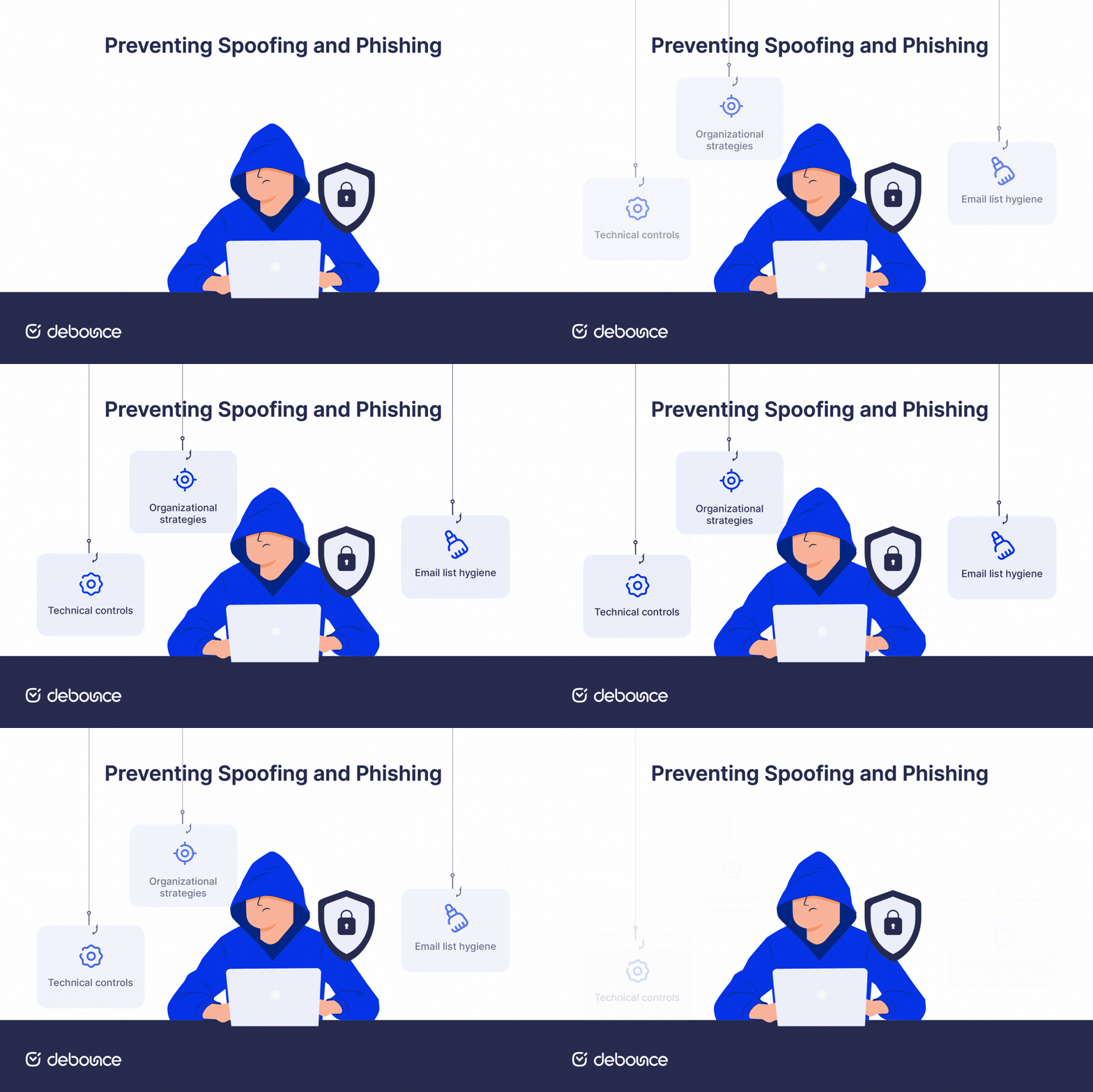
Implement DMARC at enforcement policy (p=reject or p=quarantine) to prevent unauthorized messages from using your domain in spoofing attacks. DMARC, combined with SPF and DKIM, creates a technical barrier that stops domain-level spoofing before messages reach recipients.
MFA for email accounts prevents account takeover: the most convincing spoofing method because it uses legitimate accounts. Even when phishing successfully captures passwords, MFA stops attackers from accessing accounts to send spoofed messages from real addresses.
Email filtering platforms that analyze behavioral patterns catch spoofed messages that authentication protocols miss, flagging messages that deviate from normal sending patterns, contain BEC-pattern language, or originate from suspicious infrastructure.
Technology can block a large portion of spoofing and phishing attempts, but it cannot replace human judgment. Regular training that teaches employees how to recognize spoofed senders, suspicious domains, and manipulative requests strengthens the one layer attackers still try to exploit. Hands-on simulations, where employees practice spotting and responding to realistic phishing scenarios, tend to be far more effective than passive classroom instruction.
Clear verification procedures also make a measurable difference. Financial requests should always require out-of-band confirmation using trusted contact numbers already on file, not phone numbers or links provided in the message itself. That one safeguard alone can stop most spoofing and phishing schemes that aim to trigger fraudulent payments.
Maintaining a clean email list reduces organizational exposure to both threats. Clean lists with validated contacts support accurate sender reputation signals that help security tools identify anomalies. Organizations with strong sender reputation and consistent sending patterns are harder to spoof convincingly. Email list validation removes invalid, risky, and unverifiable addresses that weaken the sending infrastructure, which attackers study when planning spoofing campaigns.
Good security for email marketers combines authentication, validated lists, and ongoing monitoring to create the consistent sending patterns that make spoofing attempts detectable through behavioral analysis.
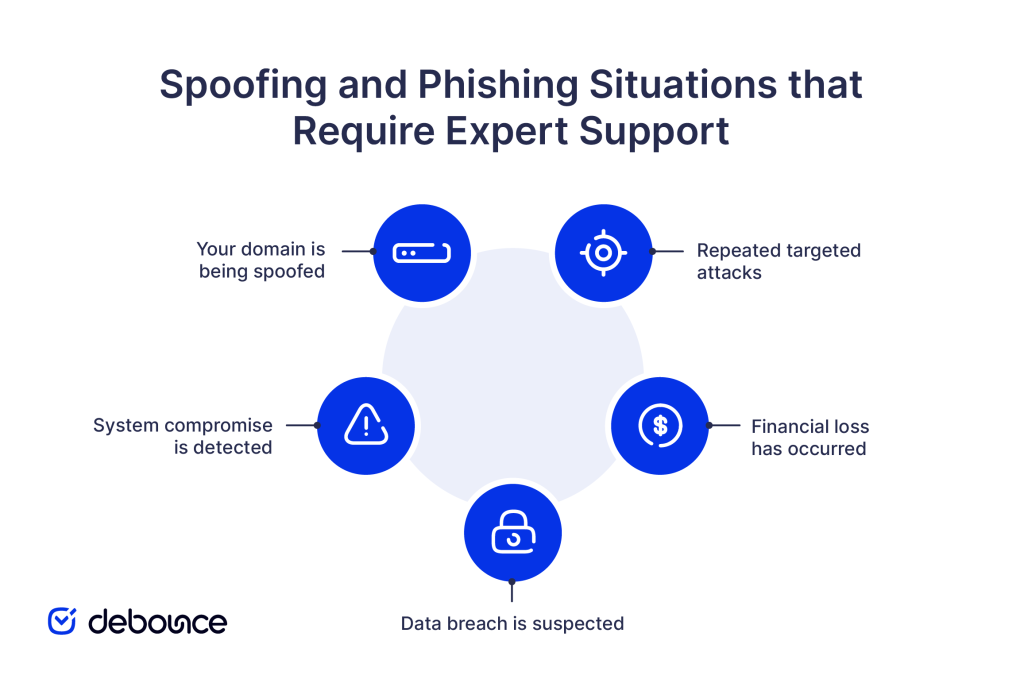
Some spoofing and phishing situations require expert support beyond internal capabilities. Seek professional help when:
Organizations whose contact databases contain invalid, outdated, or risky addresses face elevated exposure because poor list hygiene signals weak email security posture to attackers. DeBounce’s email list validation identifies and removes addresses that weaken sender reputation and increase vulnerability to spoofing campaigns targeting your domain.
Spoofing and phishing serve different roles in the attacker’s toolkit, and understanding that difference is what makes defenses effective. Spoofing fakes technical identifiers to bypass filters and build trust; phishing exploits that trust to manipulate victims into harmful actions. Together, they form the most common and costly combination in email-based cybercrime.
Defending against spoofing requires technical controls: DMARC, SPF, DKIM authentication that prevents domain forgery, and MFA that blocks account takeover. Defending against phishing requires human controls: employee training, verification procedures, and behavioral awareness that catches social engineering attempts that technical filters miss.
Check your domain’s DMARC configuration today, and assess your employee training: when did your team last practice identifying a spoofed sender address in a realistic scenario?
Maintain a clean email infrastructure as part of your long-term security and deliverability posture. Use DeBounce to validate contact lists, remove invalid and risky addresses, and maintain the consistent sender reputation that makes spoofing attempts against your domain easier to detect and block. Strong authentication and validated lists together create a foundation that reduces both spoofing and phishing risk across all your email communications.
What is the difference between spoofing and snooping?
Spoofing fakes an identity or technical identifier to impersonate a trusted source, while snooping (also called eavesdropping) passively intercepts and monitors communications without altering them. Spoofing is active deception, and snooping is covert observation.
What are the most common types of phishing?
The most common types are email phishing (mass fraudulent emails), spear phishing (targeted personalized attacks), smishing (SMS-based phishing), vishing (voice call phishing), and whaling (executive-targeted attacks).
Is spoofing always illegal?
Not always. Legitimate uses exist, such as network testing and security research using controlled spoofing environments, but spoofing carried out to commit fraud, mislead others, or inflict harm violates computer fraud laws in most jurisdictions, including the US Computer Fraud and Abuse Act.
Can you be spoofed without being phished?
Yes, your domain can be spoofed in spam campaigns or used in attacks against others without you being the phishing target; in these cases, you’re the impersonated party rather than the victim, which damages your sender reputation and requires DMARC enforcement to prevent.
Find quick answers to your questions about our pricing and plans.
How often do you interact with your email box? I bet pretty often. Whether you receive a critical business email, write a business partner, or...
Keep total bounce rates under 2% for a healthy sender reputation; anything above 5% indicates serious list quality issues. B2B and SaaS typically...

Learn which SMTP ports to use for email delivery: 25, 465, 587, or 2525. Our guide helps you choose the right port for security and...
As an email marketer, you may often encounter a formidable obstacle in your campaigns — ambiguous email bounce codes. These codes can be perplexing and...


Email lists are the foundation for an effective email marketing campaign. Building an email list is ongoing for as long as you need it to....

Mass emailing is a powerful way to communicate a message to a large audience. The goal could be anything from boosting conversions, a quick follow-up...
