
All clients expect to get some email confirmation after they've purchased an item online. It serves as proof that they've made the payment. And the...

Key Takeaways
You sent a campaign, the results came in, and now you’re staring at a number wondering whether it’s good. A good email open rate is generally around 20 to 30 percent, but that answer depends on your industry, your email type, and a privacy change that has been quietly inflating reported figures for years.
This post gives you current 2026 benchmarks, the context to read your number correctly, and the practical steps to improve it.
A good email open rate is generally between 20 and 30 percent, though it varies widely by industry and email type. Reported rates often look higher, around 35 to 45 percent, because Apple’s Mail Privacy Protection inflates opens. Treat open rate as a directional benchmark and not as an exact measure of engagement. The most useful comparison is against your own past performance and the typical range for your sector.
Published benchmarks disagree with each other for a few consistent reasons. Some datasets include Apple Mail Privacy Protection (MPP) opens, while others remove them, producing figures that differ by 15 to 20 percentage points for the same campaign type. Some sources report means, others medians. And some mix in transactional emails, which open at 45 to 55 percent, alongside promotional campaigns, making the overall benchmark look higher than it really is.
Open rates vary significantly by sector. Here are representative 2026 open rates, excluding and including Apple MPP, based on Brevo’s 2026 Marketing Orchestration Benchmark.
| Industry | Open rate | Open rate (including Apple MPP) |
| Government & Public Administration | 34.19% | 46.60% |
| Nonprofit & NGO | 27.03% | 40.52% |
| Energy & Utilities | 25.48% | 37.10% |
| Energy & Utilities | 24.72% | 35.42% |
| Professional Services & Consulting | 22.74% | 34.37% |
| Education | 22.25% | 34.19% |
| Telecommunications | 21.49% | 33.53% |
| Banking & Financial Services | 21.30% | 32.38% |
| Media | 21.29% | 34.34% |
| Entertainment | 21.26% | 37.45% |
| Information, Technology & Software | 20.68% | 30.98% |
| Real Estate & Property Management | 20.32% | 35.53% |
| Manufacturing, Automotive & Construction | 20.15% | 31.68% |
| Travel, Transportation & Tourism | 19.96% | 32.14% |
| Marketing, Advertising & Communications | 19.69% | 31.44% |
| Healthcare & Wellness | 19.47% | 34.28% |
| Hospitality & Food Services | 19.01% | 36.69% |
| Retail | 16.67% | 32.66% |
| Ecommerce | 15.50% | 30.02% |
| Other | 21.11% | 34.70% |
Government and public administration sits at the top of the table, with a 34.19% open rate excluding Apple MPP and 46.60% including it. Nonprofit and NGO senders also perform strongly, at 27.03% without MPP and 40.52% with it. These audiences often have a clearer relationship with the sender and a stronger reason to open the message.
Retail and e-commerce sit at the lower end, with open rates of 16.67% and 15.50% without MPP. Their MPP-included rates are much higher, at 32.66% and 30.02%, which shows how much Apple’s privacy changes can affect the benchmark.
When comparing your own numbers against these ranges, check whether your ESP includes or filters out Apple MPP opens. The difference can be large enough to make one campaign look average in one report and strong in another.
Industry matters, but email type can change the benchmark just as much.
The formula is simple:
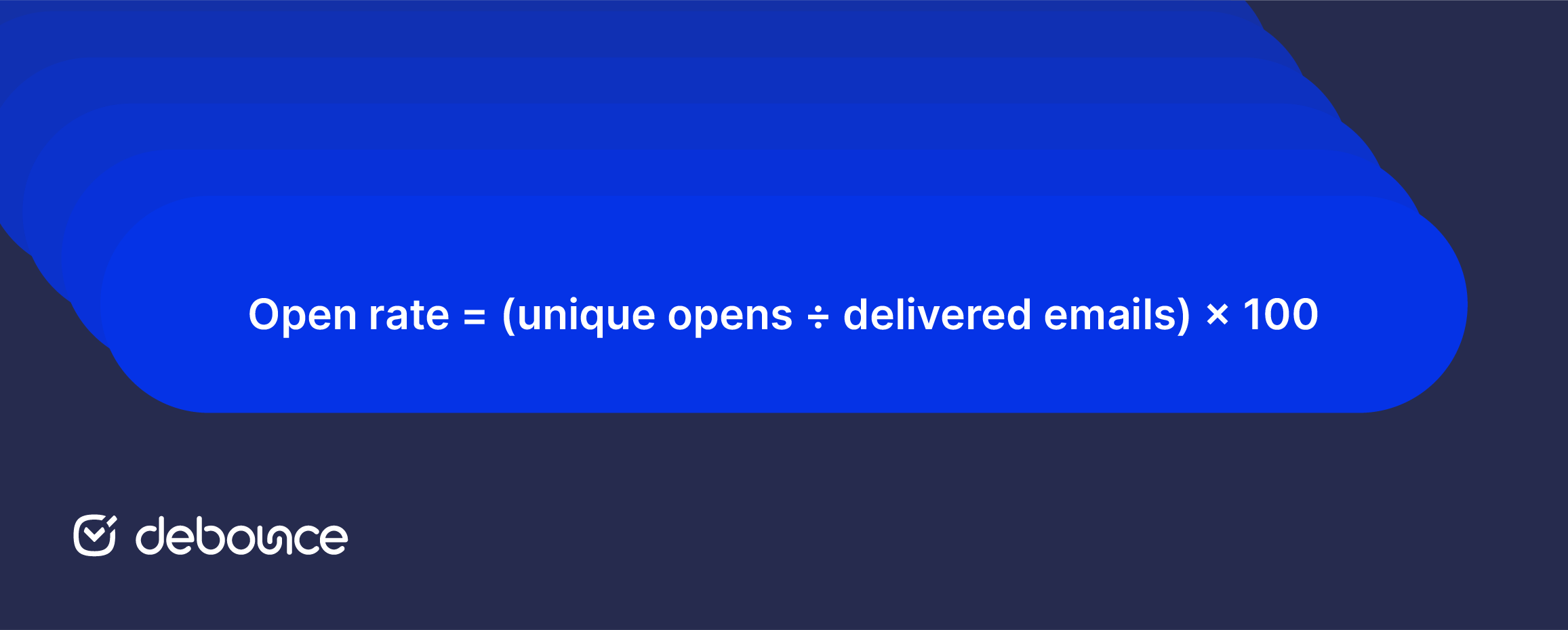
For example, if 250 people open an email and 1,000 emails were delivered, the open rate is 25%.
Use unique opens, not total opens. Total opens counts re-opens and inflates the figure. Additionally, use delivered emails as the denominator, not emails sent. Bounced messages were never eligible to be opened, so including them understates your true open rate among the people who actually received the campaign.
In September 2021, Apple launched Mail Privacy Protection with iOS 15. When enabled, Apple Mail can pre-load email content, including the tracking pixel used to record an open. That means an open may be counted even if the recipient never actually looked at the message.
Gmail and Yahoo can also pre-fetch images in some cases, though their impact is less consistent than Apple’s. For many senders, Apple Mail accounts for a large share of reported opens, especially on mobile. As a result, open rates can appear 15 to 20 percentage points higher than real human reads.
A dashboard showing a 42% open rate may be closer to 22% in actual reader activity. That does not make open rate useless. It can still help you spot trends, compare subject lines, and notice possible deliverability problems. But it should not be treated as an exact count of engaged readers. Pair it with clicks, replies, conversions, unsubscribes, and spam complaints for a more accurate picture.
Open rate is not only about subject lines. Your email needs to reach the inbox, come from a sender people recognize, and go to a clean list with content worth opening.
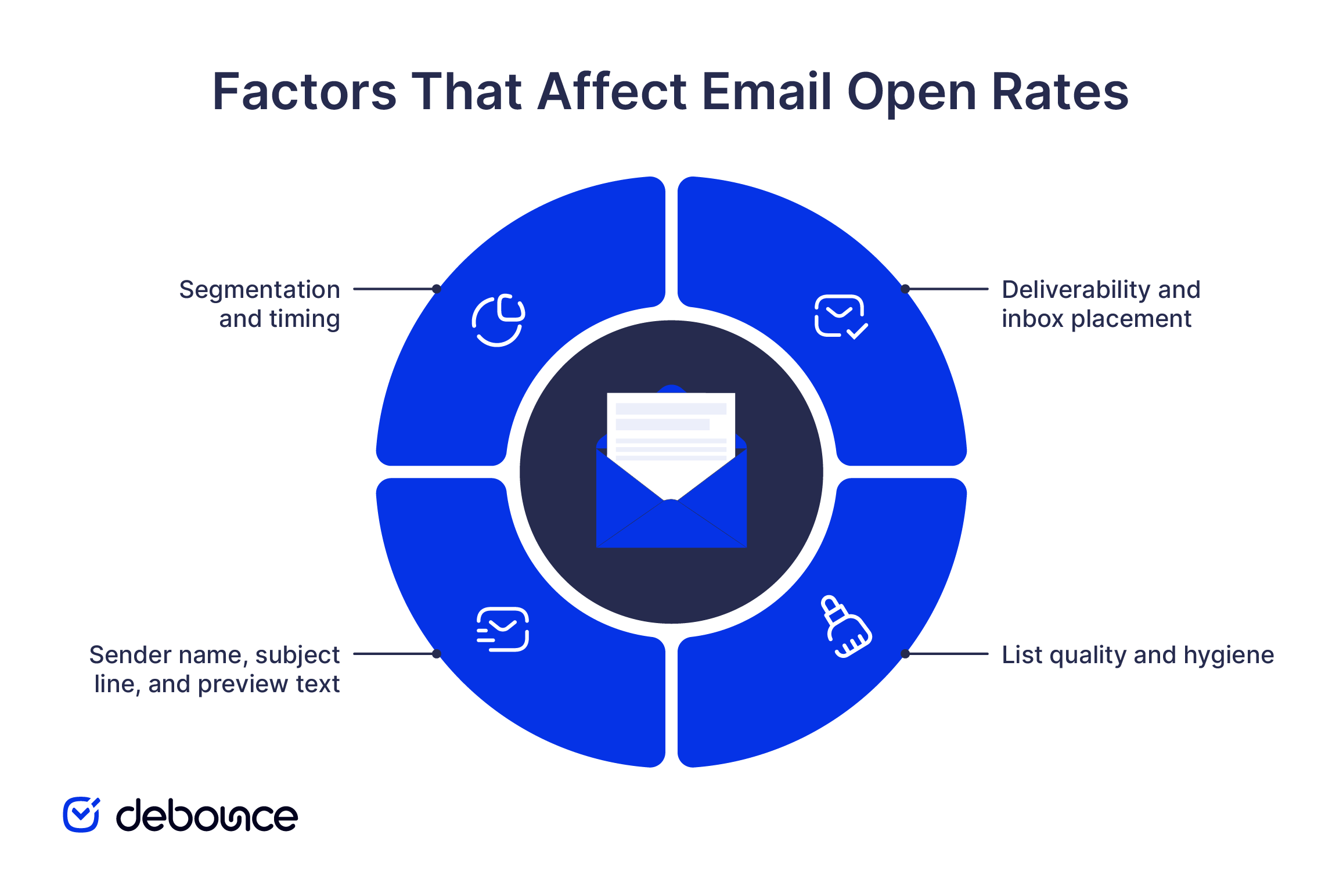
An email can only be opened if it reaches the inbox. Poor email deliverability sends campaigns to spam, where open rates collapse regardless of subject line quality. Inbox placement is determined by authentication (SPF, DKIM, and DMARC records), consistent sending volume, and a sender reputation that inbox providers have learned to trust. Without this foundation, subject-line optimization has limited impact.
List quality has a direct impact on open rate. Invalid, old, and risky addresses do not just stay inactive. They can hurt the signals mailbox providers use to decide whether your future campaigns reach real subscribers.
Sending to non-existent addresses generates hard bounces. Sending to addresses repurposed as spam traps can trigger filtering that affects your entire sending domain. Clean and verify your email list before campaigns go out, and monitor your list health on an ongoing basis. A smaller list of valid, engaged subscribers usually performs better than a large list full of outdated or risky contacts.
A recognizable sender name gives people an immediate reason to trust the email. The subject line and preview text do the persuasion work. Both need to be tested systematically, as even small changes in subject line phrasing can produce meaningful open-rate differences within the same list. Just remember that they work best when deliverability is already strong.
Segmented campaigns usually outperform batch-and-blast sends because the content is more relevant to a targeted audience. Send time and frequency matter too, but they should be tested with your own list instead of copied from general benchmarks. Over-sending trains subscribers to ignore your emails, even when they don’t unsubscribe. Over time, that lowers open rates without giving you an obvious warning sign.
To improve your email open rate, make sure your emails can reach the inbox and that your list is clean enough to protect your sender reputation. After that, you can test the creative details that influence whether people open.
Regularly clean and verify your email list and remove subscribers who haven’t engaged in a defined period. Before removing non-openers permanently, run a simple re-engagement campaign, such as “Still want to hear from us?” Then sunset the contacts who do not respond.
Authenticate your domain with SPF, DKIM, and DMARC. Keep send volume consistent instead of jumping from one email a month to ten. For new subscribers, use double opt-in so the people joining your list are real and genuinely interested.
Run A/B tests on subject lines and preview text with sample sizes large enough to produce meaningful results. Test sender name variations; some audiences respond better to a person’s name, others to a brand.
Segment your list so each message reaches the subscribers most likely to find it relevant. Tune send frequency based on engagement data. When you identify subscribers who have never opened across multiple sends, remove or suppress them before they become a deliverability rate liability.
Open rate is still useful, but it should not be the only metric you track. Privacy features can inflate opens, so pair it with metrics that show real engagement and list health.
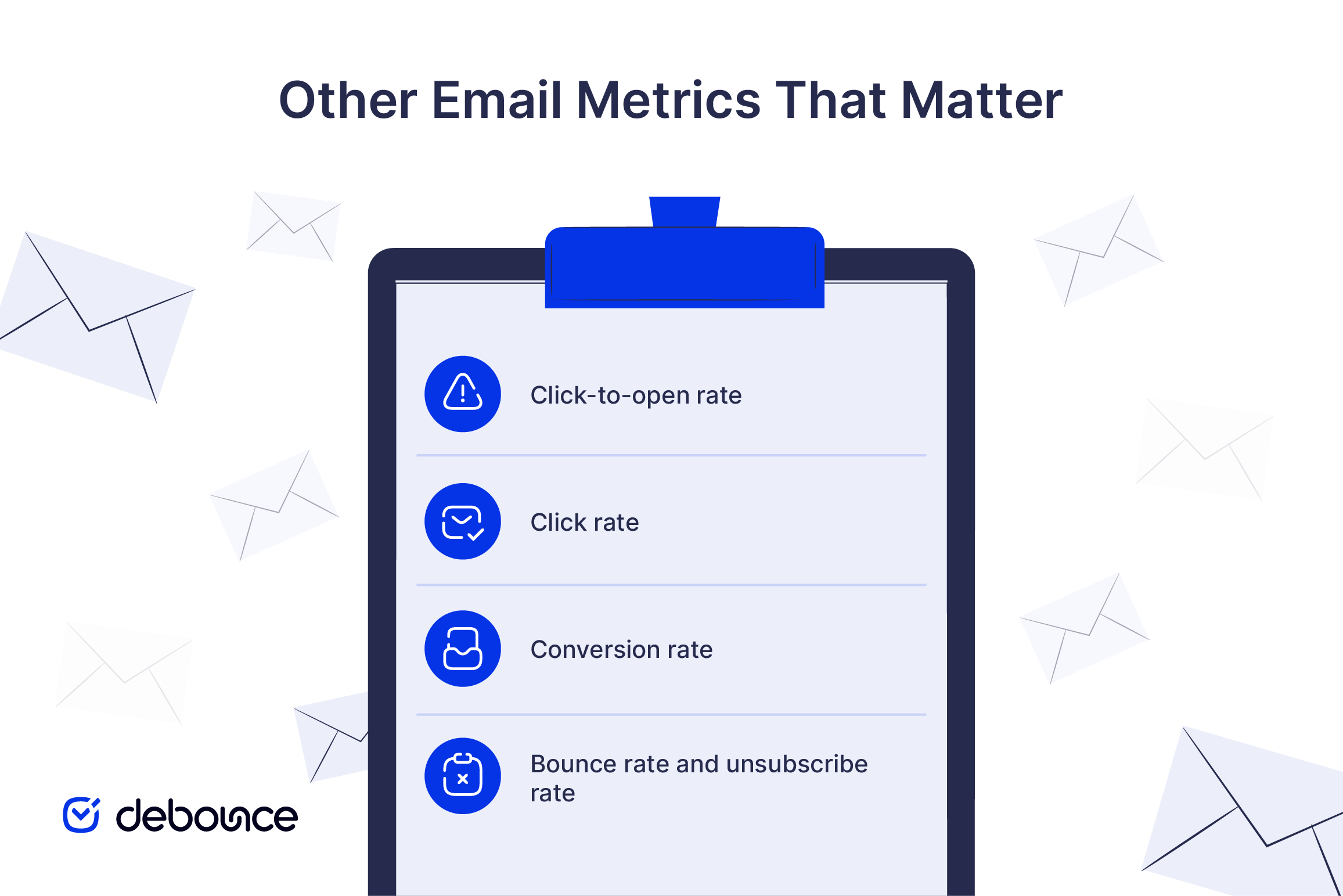
A good email open rate is usually around 20% to 30%, but that should only be a starting point. Your real target depends on your industry, email type, audience, and how much Apple MPP affects your ESP’s reporting. Read open rate as a trend indicator, validate it with click rate and CTOR, and compare it against your own historical sends.
The lever you control most directly is your list. Invalid and inactive addresses drag open rates down by damaging deliverability before any message ever reaches a real inbox. Clean and verify your email list regularly, remove contacts who’ve stopped engaging, and validate new subscribers when they sign up. A smaller, verified list consistently outperforms a large, unmanaged one.
Start with 100 free DeBounce verifications and see what is really in your list before your next send. No commitment required.
A sudden drop usually signals a deliverability problem, such as emails landing in spam, a damaged sender reputation, or a domain blocklisting. Check inbox placement and bounce rate before adjusting content or subject lines.
A 50% open rate can be real for transactional emails, small engaged lists, or highly targeted campaigns. For a typical promotional campaign, though, it may also reflect Apple MPP inflation. Check your click rate and conversions. If clicks are not rising with opens, the open rate may be overstated.
Small, focused lists often see higher open rates, sometimes 35% or more. That is usually because the audience is more targeted, more recent, and more interested. List quality matters more than list size.
Yes, but treat it as a relative signal. In a single A/B test, both subject line variants are measured under the same tracking conditions, so the comparison can still be useful. The exact open rate may be inflated, but the stronger variant can still stand out.
Verify your list every three to six months, or more often if you send at high volume or see bounce rates increasing. For better protection, connect DeBounce’s validation API to your signup forms so invalid addresses are blocked before they enter your list.
Find quick answers to your questions about our pricing and plans.
All clients expect to get some email confirmation after they've purchased an item online. It serves as proof that they've made the payment. And the...

The best list-growth tactics combine clear value (like lead magnets and landing pages), smart placement (like pop-ups and social links), and quality control...

As an email marketer, you may often encounter a formidable obstacle in your campaigns — ambiguous email bounce codes. These codes can be perplexing and...

Email marketing might not sound like the most glamorous way to promote your dropshipping business. However, any expert marketer knows just how effective this tactic...

Google Postmaster Tools V2 replaces reputation scores with compliance-based evaluation, making authentication and policy alignment the core requirement for inbox placement. The new...
Missing emails in Gmail are almost always caused by spam filtering, blocked senders or custom filters, full storage, forwarding or sync settings, or...
