
Email marketing is an integral part of every business that can give the best customer experience. It has the most efficient ROI (Return on Investment)...

Key Takeaways
A suppression list is a core part of any email marketing system, even though it often stays behind the scenes. At its simplest, it is a list of email addresses that you intentionally exclude from your campaigns.
Instead of deciding who should receive your emails, a suppression list defines who should not. It acts as a central “do not send” database, ensuring that certain contacts are automatically filtered out before any campaign is delivered.
This is not only about improving performance. It is also about protecting your sender reputation, respecting user preferences, and meeting legal requirements. When managed correctly, a suppression list becomes a safeguard that keeps your email program reliable and consistent.
Your suppression list immediately receives the address of any recipient that unsubscribes from your emails, and subsequently inform the email program not to send to the contacts anymore. It is important to note that unsubscribe groups and suppression lists are different. However, they rely on each other to function. When the recipient wants to inform the sender of their disinterest in getting their emails, they click the Unsubscribe Group. Likewise, the sender will use the suppression list to suppress sending to the members of the unsubscribe group.
Without a suppression list, clicking the unsubscribe link is futile. The emails will still go to recipients that have unsubscribed, and if this persists, the receiver will have no choice but to mark these emails as spam.
For best results, ensure that your Unsubscribe Link is clearly displayed so that receivers can easily see and use it. Otherwise, they may be forced to flag it as spam, which is bad for business.
Another information the suppression list keeps track of is the addresses that mark your message as spam. If you still send to recipients that have submitted a spam complaint, your sending reputation will be adversely affected. What spam complaints do is to tell the ISPs that you disregard the call of your recipients to stop sending them unsolicited emails. Consequently, the ISP will blacklist your domain or IP address.
The suppression list also keeps track of invalid, blocked, and bounced email addresses. Your delivery rates will be harmed if you do not stop sending emails to such addresses. The ISPs will be forced to believe that you are nonchalant towards keeping your contact list sane.
For best results, use a reliable Email Validation API to send emails to valid addresses. Such systems automatically identify problematic addresses, thus keeping your sender reputation and delivery rates safe.
Suppression lists are not always applied in the same way. Depending on how they are structured, they can control email delivery at different levels.
A global suppression list applies across all campaigns and systems. Any email address included in this list is excluded from every send, regardless of the campaign type. This is typically used for unsubscribes, spam complaints, and invalid addresses, where sending again would create compliance risks or damage deliverability.
A custom or campaign-level suppression list applies only to a specific campaign. It allows you to exclude contacts based on context rather than permanent status. For example, you might exclude existing customers from a promotion designed for new users, or remove a segment that has already received a similar offer.
A well-maintained suppression list directly supports the health of your email program by ensuring you send to the right audience and avoid unnecessary risks.
Building a suppression list is an ongoing process that requires consistency across systems and careful handling of data.
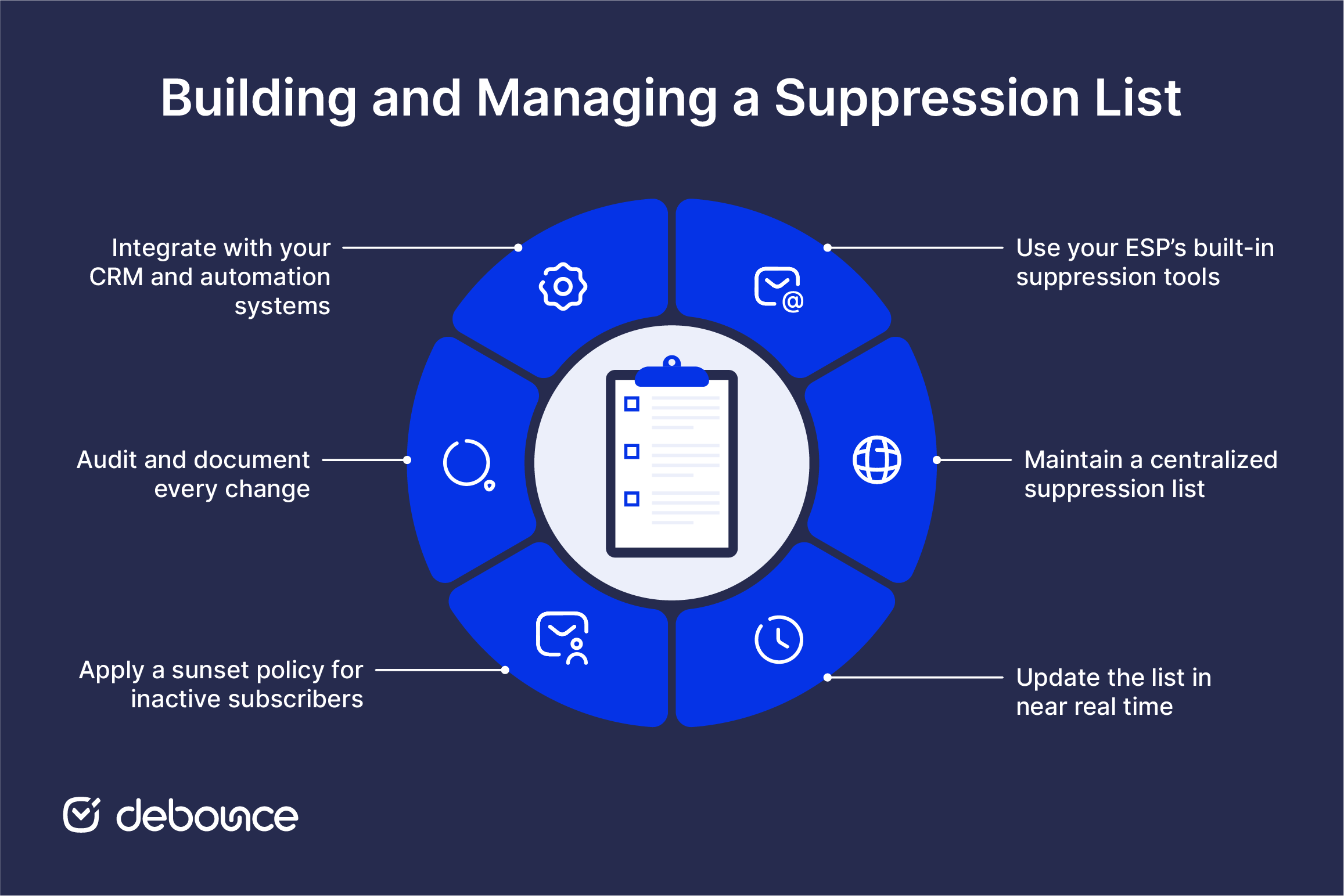
Effective suppression list management depends on consistent processes and clear boundaries across your systems.
Mistakes in suppression list management often come from gaps in the process rather than technical limitations.
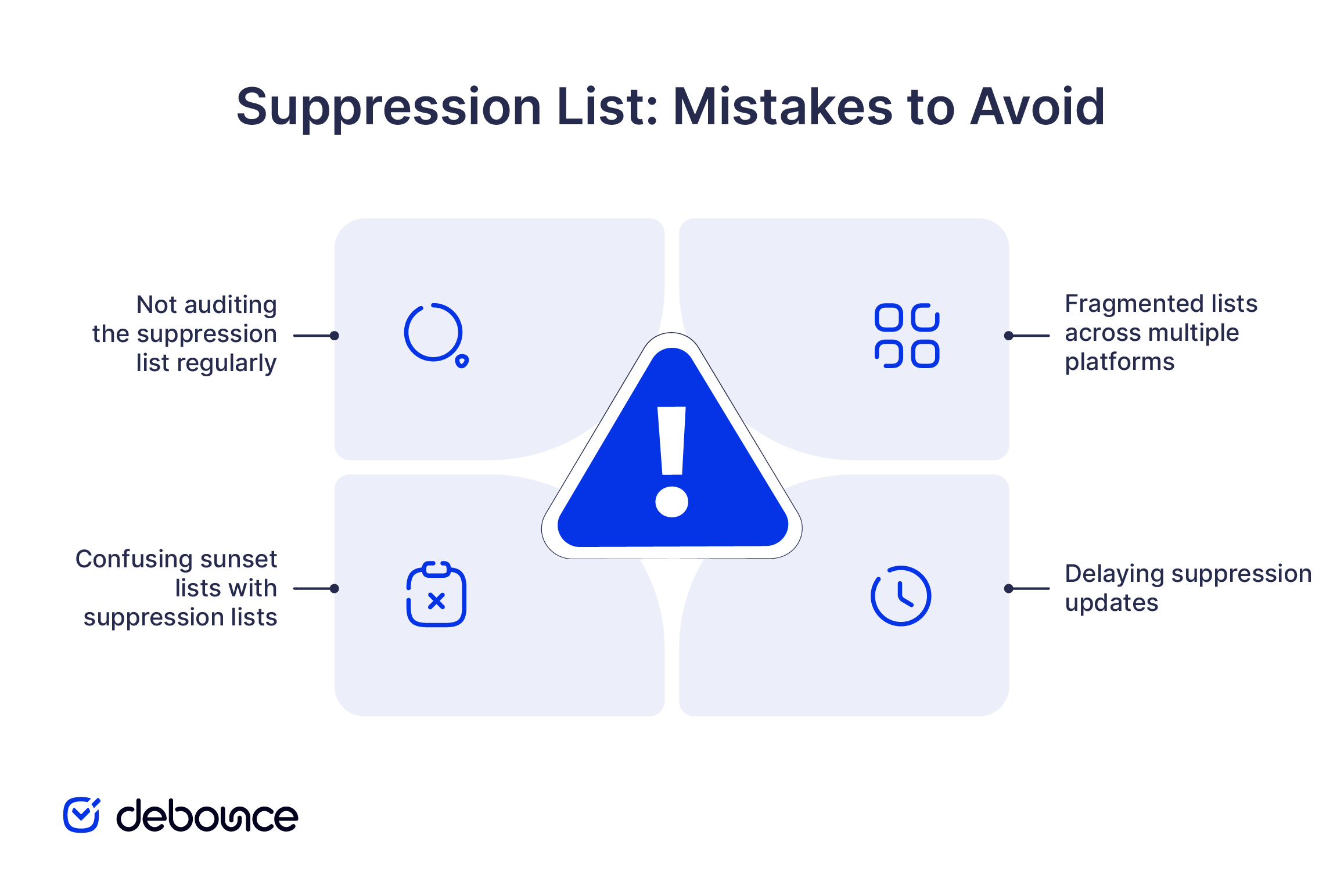
Suppression lists work quietly, but they influence every email you send, ensuring that your campaigns respect user preferences, meet legal requirements, and reach the right audience.
At the same time, suppression alone is not enough, as the quality of your overall email list still determines how well your campaigns perform.
DeBounce helps strengthen that foundation. By identifying invalid, risky, and low-quality email addresses before you send, it reduces the chances of adding problematic contacts to your system in the first place.
Keeping your list clean and your suppression data accurate works together to protect your deliverability and improve long-term results.
Yes, but only if the contact has clearly opted back in. Without explicit consent, reactivating a suppressed address can lead to compliance issues and harm your sender reputation.
Not automatically. Suppression lists need to be exported and re-imported when switching platforms or integrated through shared systems to ensure continuity.
Find quick answers to your questions about our pricing and plans.
Email marketing is an integral part of every business that can give the best customer experience. It has the most efficient ROI (Return on Investment)...

Do you frequently open your mobile phone or laptop to check your emails? If you do, then you are not alone. Because studies show that...

Spam trigger words raise filter scores when stacked together, written in all caps, or placed in subject lines that don't match the email...

This post is about the 10-point framework of a perfect welcome email to delight your new subscribers. You know the feeling of getting a brand...
🤟 Free Email Bounce Rate Calculator Looking to determine the bounce rate of your campaign or newsletter? Give our complimentary email bounce rate calculator a...

Email lead generation usually works through inbound lead capture and outbound prospecting. Inbound brings in people who show interest through your own channels,...
