Email CTR measures the percentage of recipients who clicked at least one link in your email. Low CTR can be a content, design,...

Key Takeaways
According to current email spam statistics, nearly half of all email sent globally is spam. Inbox providers have responded by building filters that evaluate hundreds of signals simultaneously, and email spam trigger words are just one of them.
The old advice that swapping out “free” for “complimentary” would fix your deliverability hasn’t been accurate for years. Modern filters at Gmail, Outlook, and Yahoo don’t maintain simple blocklists. They score emails holistically: the words matter, but so does who is sending, how authenticated the domain is, and how recipients have responded to previous campaigns.
That context is important before you audit your copy. Trigger words are worth checking, especially in subject lines, but they usually are not the main reason emails land in spam.
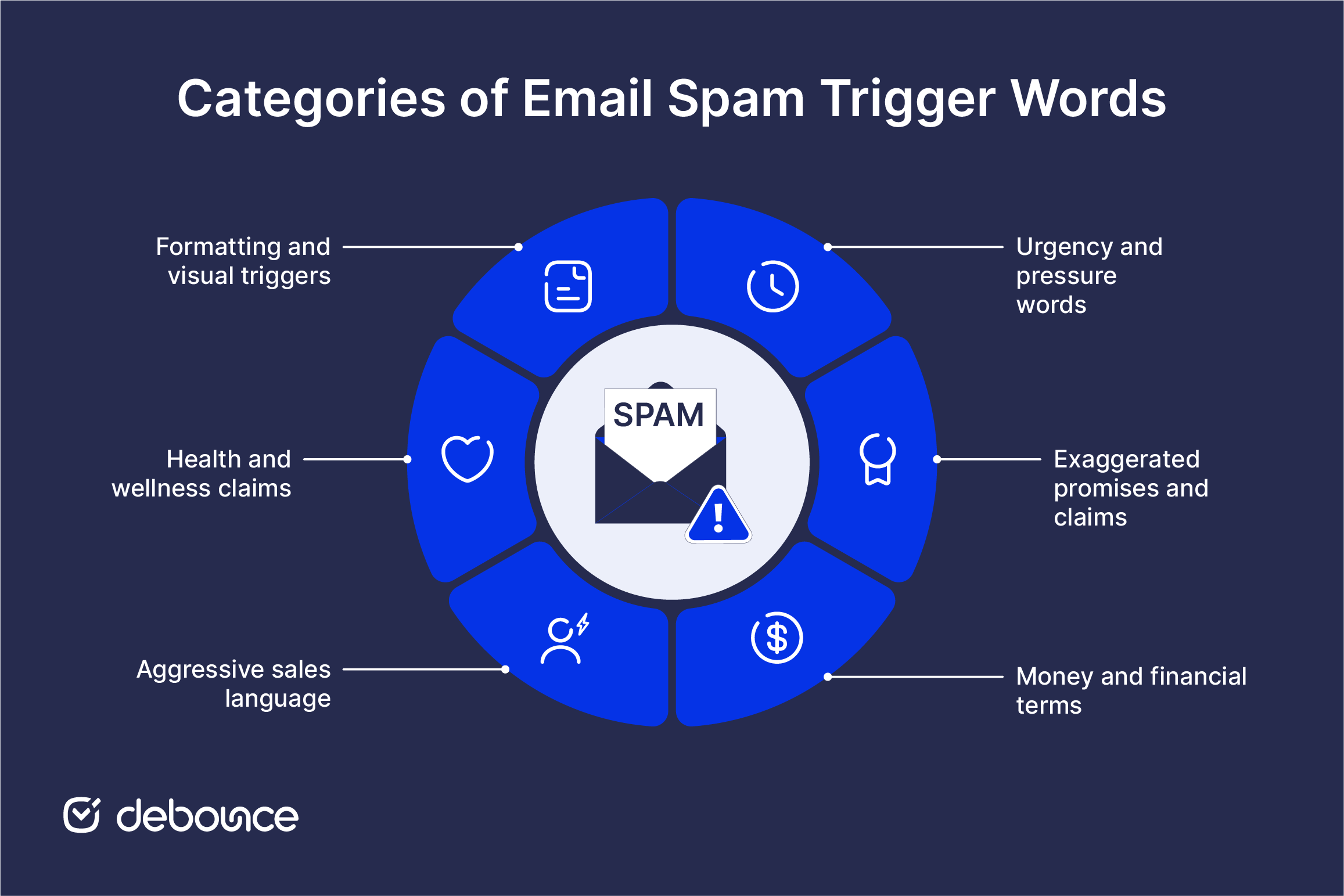
The same word can be safe or risky depending entirely on context. “Free” in a transactional confirmation email, like “Your free trial has been activated,” reads very differently to a filter than “FREE GIFT! Claim Yours NOW!!!” in a promotional subject line. What triggers filters is the combination of the word, the formatting around it, and whether it fits the overall pattern of the email.
Urgency phrases are among the most heavily flagged in spam filtering databases because they appear in the overwhelming majority of phishing and scam emails. Filters have learned to treat them as risk signals.
Common trigger words in this category:
Why filters flag them: Urgency phrases are designed to short-circuit the recipient’s judgment and push them to click without thinking. That pattern is characteristic of scam and phishing emails, which means filters treat these phrases as risky, especially in subject lines with all caps or too much punctuation.
Safer alternatives: Replace manufactured urgency with specific, factual information. Instead of “Limited time — act now,” use “Offer ends Friday, May 30” or “Available until June 1.” The urgency is still present, but it’s grounded in a real date, and not in a vague pressure tactic.
Spam filters flag exaggerated promise language because it often appears in spam and low-quality ads. The bigger or less believable the claim sounds, the higher the filter score.
Common trigger words in this category:
Why filters flag them: These phrases signal low-quality content to filters trained on millions of spam examples. They also tend to cluster: a single email rarely uses just one. When three or four appear in the same subject line or opening paragraph, the cumulative score rises quickly.
Safer alternatives: Replace claims with evidence. “Guaranteed results” becomes “trusted by 12,000 marketers.” “Amazing” becomes a specific outcome: “reduced bounce rates by 40% after one verification pass.” “Life-changing” becomes a description of the actual change (what the reader gains, in measurable terms).
Spam filters tend to treat money-related language as higher risk because it appears so often in scam emails. Words about cash, discounts, earnings, loans, or prizes can become even riskier when combined with urgency or exaggerated promises.
Common trigger words in this category:
Why filters flag them: Pairing financial language and email has a long association with fraud. “Earn money fast” and “financial freedom” appear in so much scam content that their presence alone raises a filter’s suspicion, even in legitimate emails.
Safer alternatives: Replace generic financial language with specific, accurate descriptions. “Free” becomes “included in your plan” or “at no additional charge.” “Earn money” becomes “earn 500 reward points per referral.” “Save money” becomes “save 20% on annual billing.”
Direct sales phrases score poorly because they match the pattern of low-quality bulk promotional emails. The more generic and command-like the language, the higher the filter risk.
Common trigger words in this category:
Why filters flag them: Phrases like “click here” are common in phishing emails, so filters often treat them as risky. Direct CTAs such as “buy now” or “order today” can also look like bulk promotional spam, especially in subject lines or when paired with pressure-heavy language.
Safer alternatives: Use outcome-based CTA language instead of command-based. “Click here” becomes “See your personalized report” or “Read the full guide.” “Buy now” becomes “Get started” or “Choose your plan.” The action is still clear, but the framing shifts from pressure to benefit.
Health-related spam trigger words are weighted particularly heavily because they appear in some of the most harmful scam content, such as fake cures, unapproved supplements, and fraudulent medical claims.
Common trigger words in this category:
Why filters flag them: Regulatory agencies have pursued enforcement actions against many of these claims in email marketing, and spam filter databases reflect that history. Even legitimate health and wellness brands trip these filters when they use similar phrasing without qualification.
Safer alternatives: Describe the actual mechanism and cite the actual evidence. Instead of “clinically proven to reduce stress,” write “based on a 2024 study of 500 participants, users reported 30% lower stress scores after eight weeks.” Specificity and sourcing replace the flag-triggering vagueness.

Content filters evaluate formatting as well as words. Certain visual patterns are so strongly associated with spam that they raise scores regardless of what the email actually says.
Patterns that trigger filters:
Why filters flag them: Spammers often use these formatting tricks to get around basic spam filters. Modern filters now recognize those patterns as warning signs, so the more they appear in an email, the more suspicious the message looks.
Safer alternatives: Standard sentence case for subject lines, one exclamation mark at most per email, standard spelling throughout, and restrained emoji use, if any. A subject line in normal formatting with a specific, relevant benefit statement outperforms an all-caps attention grabber on both filter scoring and open rates.
Knowing how modern spam filters work helps explain the role trigger words play today. Gmail, Outlook, and Yahoo evaluate four primary signal categories simultaneously on every incoming email:
Rule-based systems like SpamAssassin assign point scores to individual signals (trigger words included) and classify emails with a total SpamAssassin score above 5 as spam. But Gmail and other major providers go further, layering machine learning models on top of rule-based scoring to evaluate context and sender history.
Trigger words feed the content scoring component, but they usually do not send an email to spam on their own. A well-authenticated domain with a strong email sender reputation and an engaged list can send an email with several trigger words and land in the inbox. However, an unauthenticated sender with a high bounce rate will end up in spam regardless of how carefully edited the copy is.
Trigger words are worth reviewing, especially in subject lines. But inbox placement usually depends more on the signals mailbox providers use to judge whether your emails are wanted and safe to deliver.

Inbox providers have years of behavioral data on every sending domain. A domain with a consistent record of low complaints, low bounces, and high engagement earns a high level of trust. Reputation is built slowly and damaged quickly; thus, protecting it through every campaign matters more than optimizing any individual email’s word choice.
Invalid addresses generate hard bounces. Spam traps damage the reputation with inbox providers and blocklist operators. Unengaged subscribers drag down engagement metrics, which suppresses future inbox placement. None of those outcomes has anything to do with trigger words; they’re list quality problems. Running your list through Email List Validation before each major campaign removes the addresses most likely to cause these problems.
Addresses decay as people change jobs, abandon inboxes, and close accounts. A list that was clean six months ago may have a 5–10% decay rate today. Cleaning email lists every 3–6 months keeps bounce rates consistently low and ensures engagement metrics reflect real, active subscribers.
When recipients open, click, and reply, inbox providers register that your emails are wanted and route future sends accordingly. When they ignore or delete without opening, filters interpret that as a signal to route more aggressively to spam. Better content reduces complaints and unsubscribes, which builds the reputation that gets the next campaign delivered.
Email spam trigger words contribute to your content score, and stacking several in a single subject line will raise that score meaningfully. But filters care far more about who is sending than what words they use. A trusted sender with strong authentication, a clean list, and engaged subscribers has more deliverability runway than the perfect subject line can provide.
The most effective approach is rewriting hyperbolic phrases with specific, concrete alternatives that say what you actually mean. Then pair that clean copy with strong list hygiene and proper authentication.
Before your next campaign, upload your list to DeBounce and run a full validation pass. Remove the invalid, disposable, and high-risk addresses, then send to a list that’s clean enough to let your copy do the work it’s supposed to do.
Yes. Subject lines carry significantly more weight in spam scoring than body content because they’re the first signal filters evaluate, and they’re where spammers concentrate their most aggressive language. A trigger word in the body of an otherwise clean email scores lower than the same word in the subject line paired with all-caps formatting.
Use outcome-based language that describes what happens when the recipient takes action, such as “See your results,” “Read the full breakdown,” “Get your free report,” or “Reserve your spot.” These phrases communicate the benefit rather than issuing a command, which both filters and recipients respond to better.
To a meaningful degree, yes. Inbox providers weigh sender reputation heavily, and a domain with a long record of low complaints, low bounces, and high engagement has more tolerance for content signals that would flag a less established sender. That said, stacking multiple trigger words with aggressive formatting in a subject line will raise scores even for trusted senders; the better approach is to fix both.
Find quick answers to your questions about our pricing and plans.

Email CTR measures the percentage of recipients who clicked at least one link in your email. Low CTR can be a content, design,...

AI helps email marketers send messages that feel more personal, even when reaching large audiences. It adjusts content, timing, and targeting based on...

If you’ve been in the business long enough, you’ve probably heard of at least a few significant data breaches involving small and medium-sized businesses, small...


A PTR record maps an IP address back to a hostname, and mail servers use it to verify the network-level identity of a...

Links in the email are like fire. What do I mean? They are beneficial if used correctly. Yet, they can cause severe damage if you...


When cleaning up your email, remove promotional emails, old newsletters, and spam in bulk rather than one by one. Clean your primary work...