
20–25% is a solid open rate for most marketing emails; above 40% is excellent, while below 15% can indicate potential issues. Open rates...

Key Takeaways
Email marketing success depends on list quality. Even the most compelling message will fail if it never reaches the inbox.
What many marketers underestimate is the reality of list decay. Email addresses naturally become invalid over time due to job changes, abandoned accounts, domain shutdowns, and simple user inactivity. According to recent email deliverability statistics, sender behavior and list hygiene remain among the strongest predictors of inbox placement.
When a database is not maintained, performance declines quickly. A messy list results in rising bounce rates, more spam complaints, wasted budget, and gradual damage to your email sender reputation.
Email list cleaning addresses this problem directly. It is the structured process of pruning invalid, inactive, and high-risk addresses from your database. If you are serious about improving performance and protecting your domain, understanding how to clean an email list properly becomes a foundational practice.
Inbox providers now apply stricter filtering standards and closely monitor sender behavior. Reasons cleaning your email list matters include:
Effective list cleaning follows a structured, multi-step workflow. It combines engagement analysis, bounce monitoring, spam trap detection, and automated validation.
The strongest results come from pairing human oversight with automated validation tools such as DeBounce’s Email List Validation.
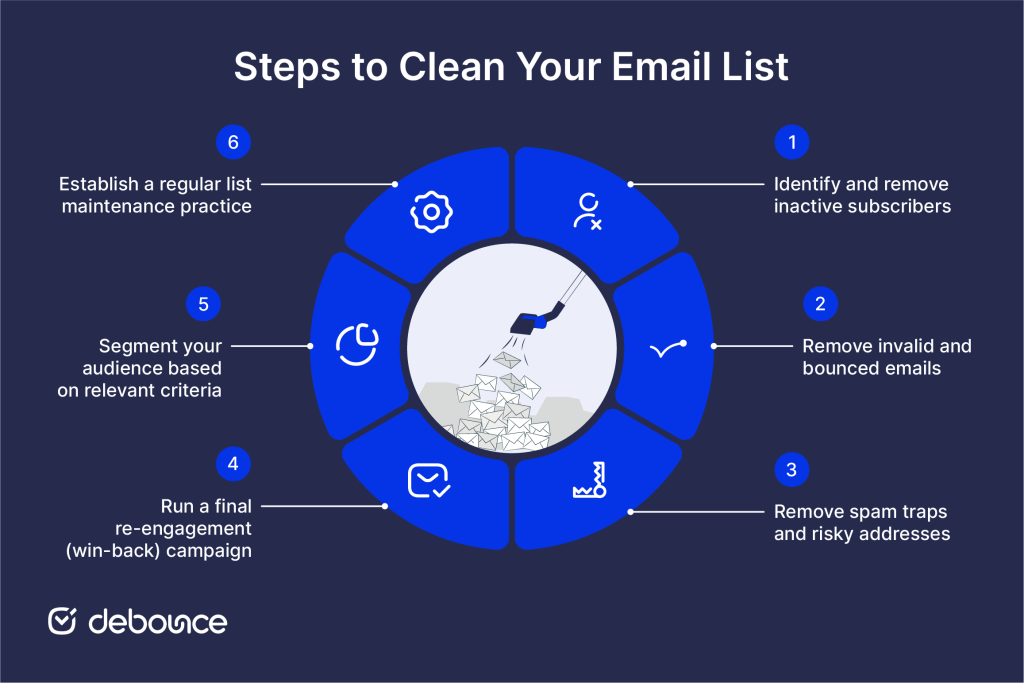
Inactive subscribers are contacts who have not opened or clicked within a defined period, typically 90 to 180 days. Removing or re-engaging these contacts is essential because a healthy, responsive list forms the foundation of a successful email marketing campaign.
To identify inactivity:
DeBounce supports this process by validating whether addresses are still deliverable and flagging dormant accounts before they affect your bounce rate.
Understanding the difference between hard and soft bounces is critical. Hard bounces indicate permanent failure, while soft bounces are temporary. Common causes include:
Review your ESP reports carefully and remove hard bounces immediately to protect your email sender reputation.
DeBounce detects invalid and non-existent emails before sending, helping prevent bounce spikes.
Spam traps are hidden addresses used to detect poor list hygiene. There are pristine traps, recycled traps, and typo traps. Understanding how each works is essential to protecting deliverability.
Risky addresses also include:
DeBounce checks for syntax errors, domain validity, and high-risk patterns that often indicate spam traps or disposable usage.
Before permanently removing inactive subscribers, consider running a short win-back campaign to give them one final opportunity to engage. Offer a clear incentive such as exclusive content, early access, or a limited discount to renew their interest.
Focus this effort on users who fall within your defined inactivity window. If they still do not respond, it is best to remove them and protect the overall health of your list.
Segmentation strengthens relevance and personalization by ensuring subscribers receive content that aligns with their behavior and interests.
You can segment your list based on:
When your data is clean and accurate, these segments become far more precise, allowing you to deliver targeted messaging that meaningfully increases email list engagement.
List cleaning should not be treated as a one-time task. Ongoing maintenance protects your deliverability and keeps performance stable over time. As a general rule, high-volume senders benefit from monthly hygiene checks, while mid-size lists should be reviewed at least quarterly. It is also wise to validate your list before launching any major campaign to avoid sudden bounce spikes.
Automating validation prevents dirty data from entering your system. Integrating the Email Validation API directly into signup forms blocks invalid or disposable emails at the source.
In addition, continuous Email List Monitoring helps you detect decay patterns, engagement drops, or risk signals early. If you are actively trying to build an email list, validating contacts as they join is essential.
Before you begin cleaning your database, take a moment to prepare properly. A structured approach reduces the risk of accidental data loss, protects valuable contacts, and ensures your cleaning efforts align with your broader marketing goals.
Not all bad emails are the same, but each one can negatively affect your email sender reputation and overall deliverability. Identifying and addressing them properly is essential to maintaining a healthy database.
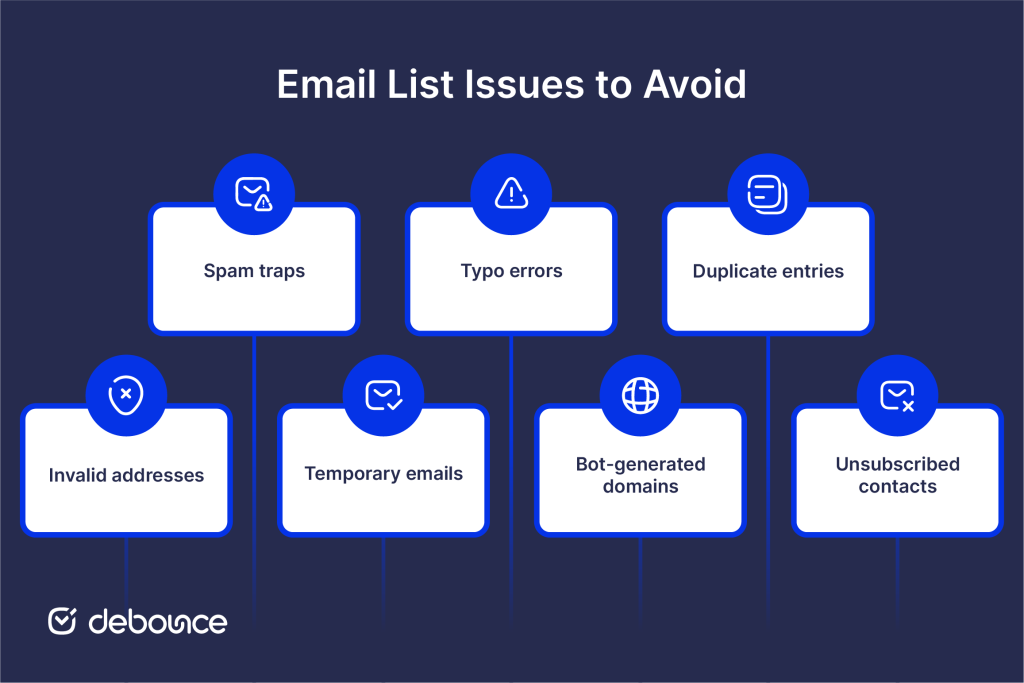
Common issues include:
Disposable and temporary addresses are increasingly used in fraud. Many email security companies emphasize early detection of these patterns because preventing them at the point of capture is far more effective than repairing reputation damage later.
Proactive list cleaning is a strategic safeguard for every email marketing campaign you send. When your database is healthy, your metrics reflect real audience interest. Campaign insights become more accurate, segmentation becomes more precise, and performance trends become easier to interpret.
A clean list improves engagement because you are communicating with subscribers who actually want to hear from you. It reduces your bounce rate by eliminating invalid and outdated addresses before they cause delivery failures.
If your goal is to eliminate spam traps, reduce invalid addresses, and maintain long-term deliverability, the process should begin with validation. Scanning your database with DeBounce allows you to identify risky, inactive, and problematic contacts before they affect performance. Cleaning your list today protects your campaigns tomorrow and strengthens the foundation of your entire email marketing strategy.
Most businesses should clean quarterly. High-volume senders should validate monthly or before major campaigns.
In the short term, the list size may shrink. In the long term, performance improves. Removing inactive and invalid contacts increases engagement rates, improves bounce metrics, and strengthens your email sender reputation.

Find quick answers to your questions about our pricing and plans.

20–25% is a solid open rate for most marketing emails; above 40% is excellent, while below 15% can indicate potential issues. Open rates...
Fake emails rely on urgency, impersonation, and visual tricks. Learning the signs lets you slow down and evaluate before acting. Sender domain mismatches,...
Spam traps help inbox providers and anti-spam organizations identify senders who acquire addresses through poor practices. There are three main spam trap types:...

Free SMTP servers are best suited for low-volume sending, testing, and small applications, rather than large-scale campaigns. Free SMTP providers typically impose strict...

Email lists are the foundation for an effective email marketing campaign. Building an email list is ongoing for as long as you need it to....

If your email campaigns suddenly start bouncing, open rates plummet overnight, or clients report that they never receive your messages, there’s a strong chance your...
