When it comes to Online Marketing, Newsletters make a very important part of it. Today I Aabhas Vijay from smtpservers.co will cover all about newsletters...

Key Takeaways
They say: “The money is in the list.” But if your list is packed with fake addresses, disposable emails, or people who never actually chose to hear from you, that “money” quickly turns into a wasted budget. The real challenge isn’t just collecting more signups, but attracting the right ones and keeping your list healthy enough that your emails actually reach real people.
Whether you’re building from zero or trying to speed up slow growth, the strategies below walk you through practical approaches, including lead magnets, landing pages, referral programs, and paid ads. With around 4.5 billion email users worldwide, email is still one of the most direct ways to connect with your audience. The real question is how you fill that channel with people who genuinely want to hear from you.
This guide shows you how to grow your email list in a sustainable way: by earning trust, delivering real value, and ensuring every new address in your database is legitimate.
The tactics below range from beginner-friendly to more advanced, but all share one trait: they attract subscribers who actually want to be on your list. Work through them in any order that fits your current setup.
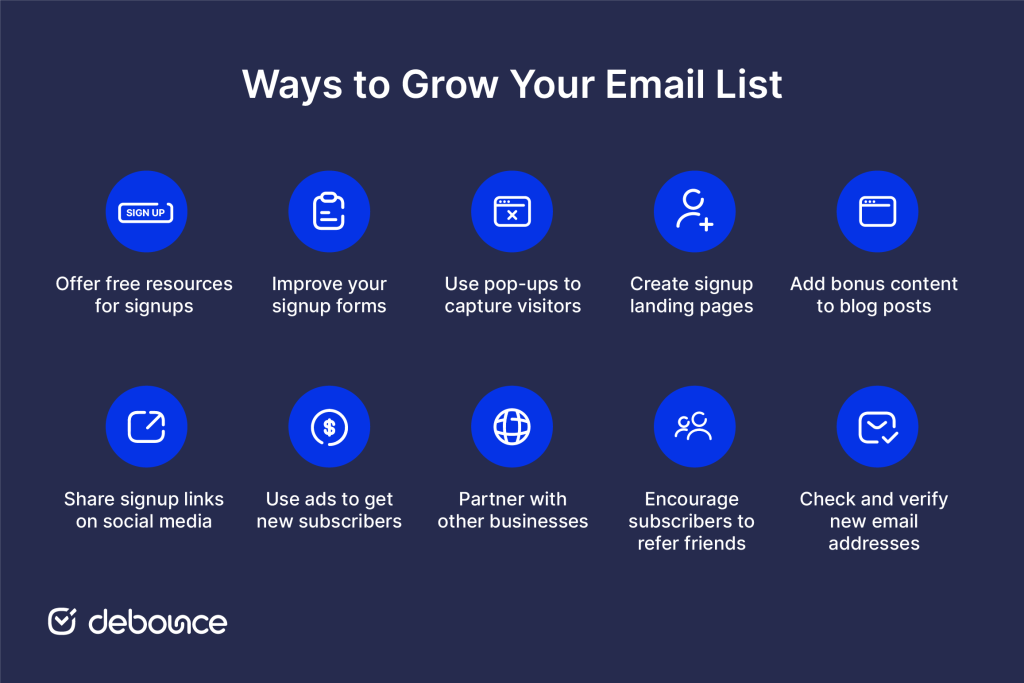
A lead magnet is anything of real value you offer in exchange for an email address. These can be templates, checklists, eBooks, mini-courses, swipe files, or free tools. The keyword is “real,” hence, if the resource doesn’t solve a genuine problem your audience has, most people won’t bother.
Good lead magnets work because they make the value of subscribing immediately obvious. Someone who downloads your “2025 Email Deliverability Checklist” already knows why they signed up and what to expect from your emails going forward. That context makes them far more likely to stay engaged.
Match the lead magnet to the audience segment you want to attract. A cheat sheet aimed at beginners will draw a different crowd than an API integration guide aimed at developers, and that’s exactly the point.
A signup form that nobody sees won’t do much for your list. Placement matters as much as design: forms in your header, after blog posts, and in the sidebar consistently outperform ones buried in the footer. Make it easy to spot and even easier to fill out.
Keep the form itself minimal. Ask only for what you actually need: in most cases, that’s just an email address, and maybe a first name for personalization. Every extra field you add reduces conversion rate.
Mobile optimization is non-negotiable. More than half of web traffic is mobile, and a form that’s hard to tap or takes forever to load will cost you signups. Test your forms on a phone before you publish them.
Pop-ups have a reputation problem, but that’s mostly because of poorly timed, impossible-to-close ones. Done well, they’re one of the highest-converting tools for list growth. There are three types worth knowing about:
Use one type per page and make sure the offer is relevant to the content. A generic “Sign up for our newsletter” pop-up rarely converts as well as one that says “Want the checklist for this post? Enter your email.”
A dedicated landing page built around a single goal (getting an email signup) removes every distraction that might pull a visitor away. No navigation menu, no links to other blog posts, no sidebar widgets. Just a headline, a benefit statement, and a form.
Landing pages work especially well when you’re running a specific campaign, promoting a lead magnet, or driving traffic from a single source like a social bio or a podcast mention. Because the page only does one thing, you can test and refine it until it converts well, then send more traffic to it.
Keep the copy focused on what the subscriber gets, not on what you want. “Get the free deliverability guide” outperforms “Join our mailing list” every time.
If someone reads 80% of a blog post, they’re interested in the topic. That’s the perfect moment to offer something that goes deeper, like a downloadable version of the post, a related worksheet, an expanded checklist, or a case study that builds on what they just read.
This technique is called a “content upgrade,” and it works because the offer is hyper-relevant to what the reader already wants. Instead of asking everyone who visits your site to join your general newsletter, you’re offering something directly tied to the topic they’re actively exploring, making the decision feel useful rather than promotional.
Place the offer inline (mid-article or at the natural end of a key section), not only at the bottom of the post. Contextual placement converts better than afterthought placement.
Social media followers and email subscribers aren’t the same thing. Followers see your content when the algorithm decides to show it; subscribers see it when you choose to send it. Moving people from one channel to the other is worth the effort.
Add a link to your signup page or lead magnet in your bio on every platform you use actively. On Instagram, use the “Link in Bio” field and reference it in your content. On LinkedIn, you can include a link in posts and carousels without it killing reach the way links do on some other platforms.
Post consistently about the value subscribers get. For example, instead of just “sign up for my newsletter,” use “this week I sent subscribers a breakdown of the three email metrics most teams ignore,” to show them what they’re missing.
Paid ads can accelerate list growth significantly, especially if organic channels are slow. Meta Lead Ads and LinkedIn Lead Gen Forms are particularly effective because they let users submit their email directly in the platform (no clicking through to a landing page, no form friction).
Target by interest, job title, or behavior to reach people likely to value your content. A well-targeted ad with a specific offer (“Download the free B2B email audit template”) will outperform a generic “Subscribe to our newsletter” ad.
Track cost-per-subscriber and monitor engagement metrics for ad-acquired subscribers separately. If engagement is low, tighten your targeting or improve the lead magnet, rather than just spending more.
Co-marketing with non-competing brands that share your audience is one of the most underused list-growth tactics. Guest webinars, co-authored guides, and newsletter cross-promotions let both parties reach each other’s audiences in a way that feels credible rather than transactional.
Look for partners with similar audience profiles but different products. A project management tool and a freelance invoicing platform, for example, serve the same people but aren’t competing for the same business. A joint webinar on “Running a Lean Freelance Operation” gives both parties new subscribers and positions them both as helpful resources.
Referral programs turn your current subscribers into recruiters, and people who join through a personal recommendation tend to be higher-quality subscribers than those who found you through a generic ad.
Tools like SparkLoop make it straightforward to build a “referral loop”: your current subscribers get a unique referral link, and they earn rewards (exclusive content, merchandise, credits) for each new person they bring in. The reward needs to be something subscribers actually want, or the loop won’t turn.
Even if you don’t use a dedicated referral tool, you can start small. Add a simple line to your welcome email or confirmation page that says, “Know someone who’d find this useful? Forward this email.” Word-of-mouth growth tends to move slowly, but the subscribers who come in that way are often some of the most engaged people on your list.
Growing a list is easy to undo with the wrong addresses. Disposable emails (used to grab a free resource and then abandoned), invalid syntax, role-based addresses like “info@,” and outright fake entries all add up quietly. Left unchecked, these issues weaken deliverability, damage sender reputation, and reduce the effectiveness of every campaign you send.
That’s where Email List Validation comes in. DeBounce runs layered checks on every address, including syntax validation, DNS and MX lookups, SMTP-level mailbox checks, disposable provider detection, and risk classification, to flag addresses that don’t belong on your list before they cause problems.
For ongoing growth, Email List Monitoring keeps your connected lists re-validated on a schedule, so addresses that decay over time get caught without manual exports. Clean signups from the start, and clean lists over time. That’s the combination that protects your email sender reputation and keeps your campaigns landing in the inbox.
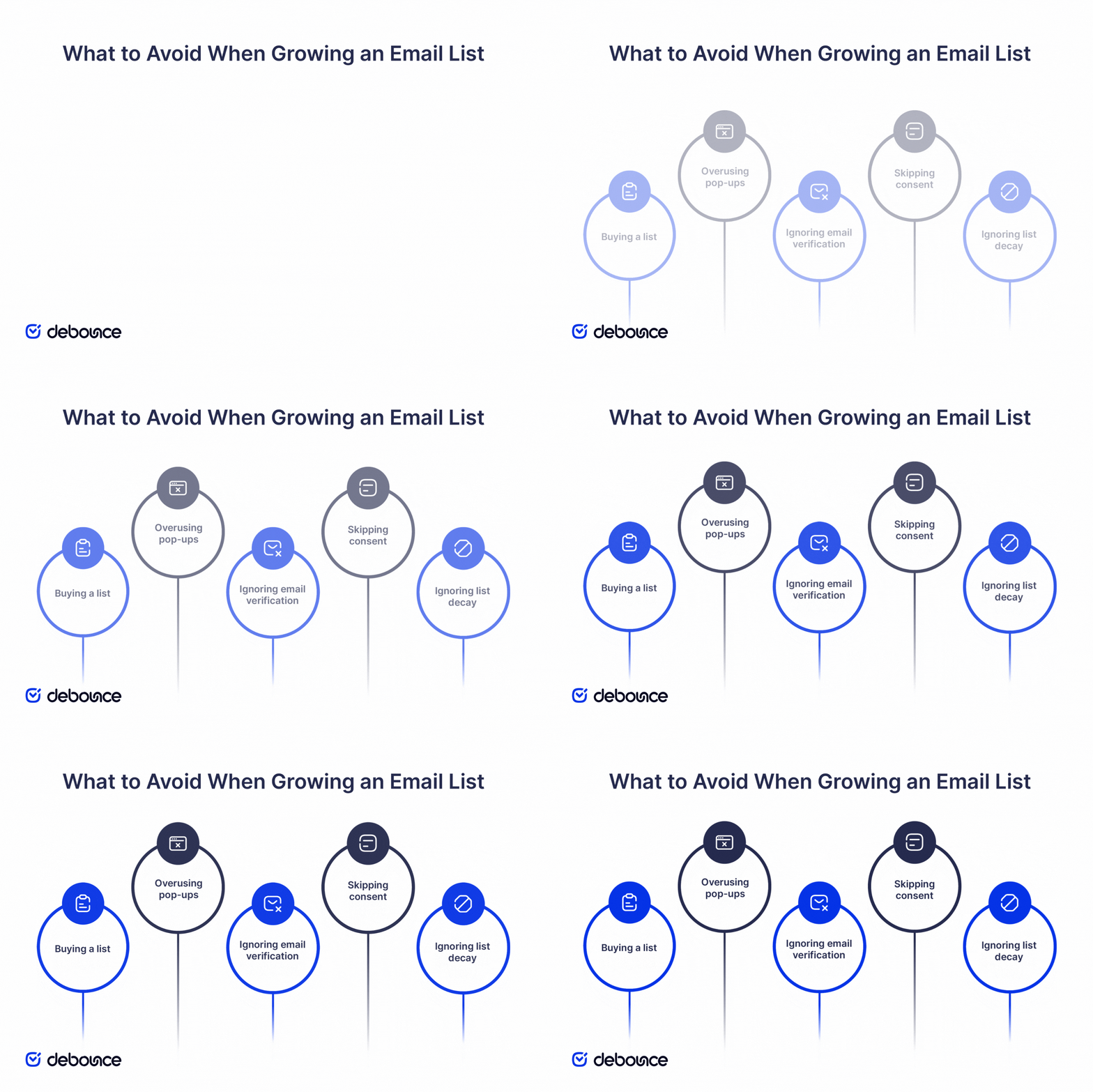
Growing fast is only valuable if what you’re building is solid. Here are the most common errors that undermine list quality, deliverability, and long-term engagement:
Purchased lists are almost always low quality. They’re full of stale addresses, role-based emails, and contacts who never consented to hear from you. Sending to a bought list is the fastest way to hit hard bounces or soft bounces and damage your sender reputation.
Adding people to your list without their permission isn’t just an ethical problem; it’s a compliance risk under GDPR, CAN-SPAM, and similar regulations. Sending messages to people who never agreed to receive them increases the likelihood of complaints, unsubscribes, and potential legal consequences. Only send emails to individuals who have clearly and explicitly opted in.
Letting invalid and disposable addresses pile up leads to high bounce rates, spam complaints, and poor inbox placement. Regular email verification helps identify and remove these risky addresses before they damage your sender reputation. A clean list isn’t just a best practice; it’s what makes everything else in your email program work.
Too many pop-ups, or ones that appear immediately on every page visit, frustrate users and can increase bounce rates on your site. They interrupt the reading experience before visitors have had a chance to engage with your content. Use them strategically, not reflexively.
Even a list built through clean, permission-based signups will naturally degrade over time as people change jobs and abandon old addresses. Regular re-verification helps catch inactive, invalid, and risky contacts before they affect deliverability. It keeps your email list clean and your sender reputation protected.
You can’t improve what you don’t track. Measuring list growth means understanding the quality and trajectory of your list at each stage.
The three metrics that matter most:
Keep an eye on hard bounce rates as a separate indicator. A spike in hard bounces after a particular signup source is a sign that the source is delivering low-quality addresses, and that verification should be added to that entry point.
Use Email List Monitoring to catch address decay automatically, and Email List Validation to run a full cleanup before major sends so every campaign starts with a healthy foundation.
A bigger email list isn’t automatically a better one. The strategies in this guide are designed to attract real subscribers: people who opted in because something you offered was worth it to them. That kind of list is far more valuable than one padded with fake addresses and disengaged contacts who never wanted your emails in the first place.
Quality and quantity can coexist, but quality has to come first. Offer something useful. Make it easy to sign up. Keep the experience relevant. And verify every address that comes through your forms so invalid emails don’t silently erode your email list engagement and deliverability.
DeBounce makes that last part straightforward. Upload your list, run a validation pass, and remove the addresses that shouldn’t be there before your next send. No emails are sent during validation, no impact on your IP, and no long-term contract required. Start with the addresses you have and build from there with confidence.
How to grow your email list with Instagram?
Add a direct link to your signup page or lead magnet in your Instagram bio, and reference it in posts and Stories with a clear benefit (“Get the free checklist; link in bio”). Reels and carousels that provide genuine value are also effective at driving followers to your link.
Is it better to have a large email list or a small, engaged one?
A smaller, engaged list almost always outperforms a large, disengaged one. Better open rates, click rates, and sender reputation all come from subscribers who actually want your emails. Focus on attracting the right people and removing invalid or unengaged contacts rather than chasing raw subscriber counts.
How often should I clean my email list?
Verify your list before major campaigns or any send to a list you haven’t emailed in three or more months. With ongoing email list monitoring, your connected lists are re-validated automatically, so you’re not relying on manual exports to catch decay.
Find quick answers to your questions about our pricing and plans.
When it comes to Online Marketing, Newsletters make a very important part of it. Today I Aabhas Vijay from smtpservers.co will cover all about newsletters...
Your email marketing isn't getting through. What can be done about it? What are the reasons why your email marketing may not be getting through?...

I'm sure you've noticed that there are companies with compelling email marketing campaigns that score the prestigious email marketing ROI: (Source) I'm also sure that...

Are you using influencers for brand awareness? If not, here are some statistics that may interest you. You fall in the 7% who are not...

Believe it or not, the majority of our business transaction happens via email. So much so that in 2023, there were an estimated 4.2 billion...

As more and more of us choose to run important parts of our personal and professional lives on the go, staying connected digitally is becoming...