
A healthy email unsubscribe rate is below 0.5% per campaign; above 1% is a consistent red flag worth investigating across content, frequency, and...

Key Takeaways
You fill out the signup form for Mailchimp, Brevo, Mailjet, Klaviyo, or another email service provider — then compliance declines the account. The email is polite, short, and almost uselessly vague. That experience is common, and it is usually about risk control, not a personal judgment of your business.
ESPs share sending infrastructure and reputation with mailbox providers. One customer blasting purchased lists can hurt deliverability for everyone on nearby IPs. So new accounts get reviewed: list size, collection method, send frequency, sample content, domain and DNS history, and related public signals.
This guide explains why approvals fail, what ESP questionnaires are really screening for, how to prepare before you apply, what to do if you were already rejected, and how to stay approved after you get in.
Think about what an ESP actually sells. It sells delivery. If its emails stop reaching inboxes, its business stops working. On a shared IP pool, every sender shares reputation signals with Gmail, Outlook, Yahoo, and other mailbox providers. One abusive account can get that IP flagged — and legitimate brands on the same pool start landing in spam through no fault of their own.
That is why modern ESPs run protection at every stage:
A few years ago, many providers were looser at signup. Spam pressure forced stricter vetting. Today, vague “we cannot approve your account” replies are normal because revealing exact scoring logic would help bad actors evade it.
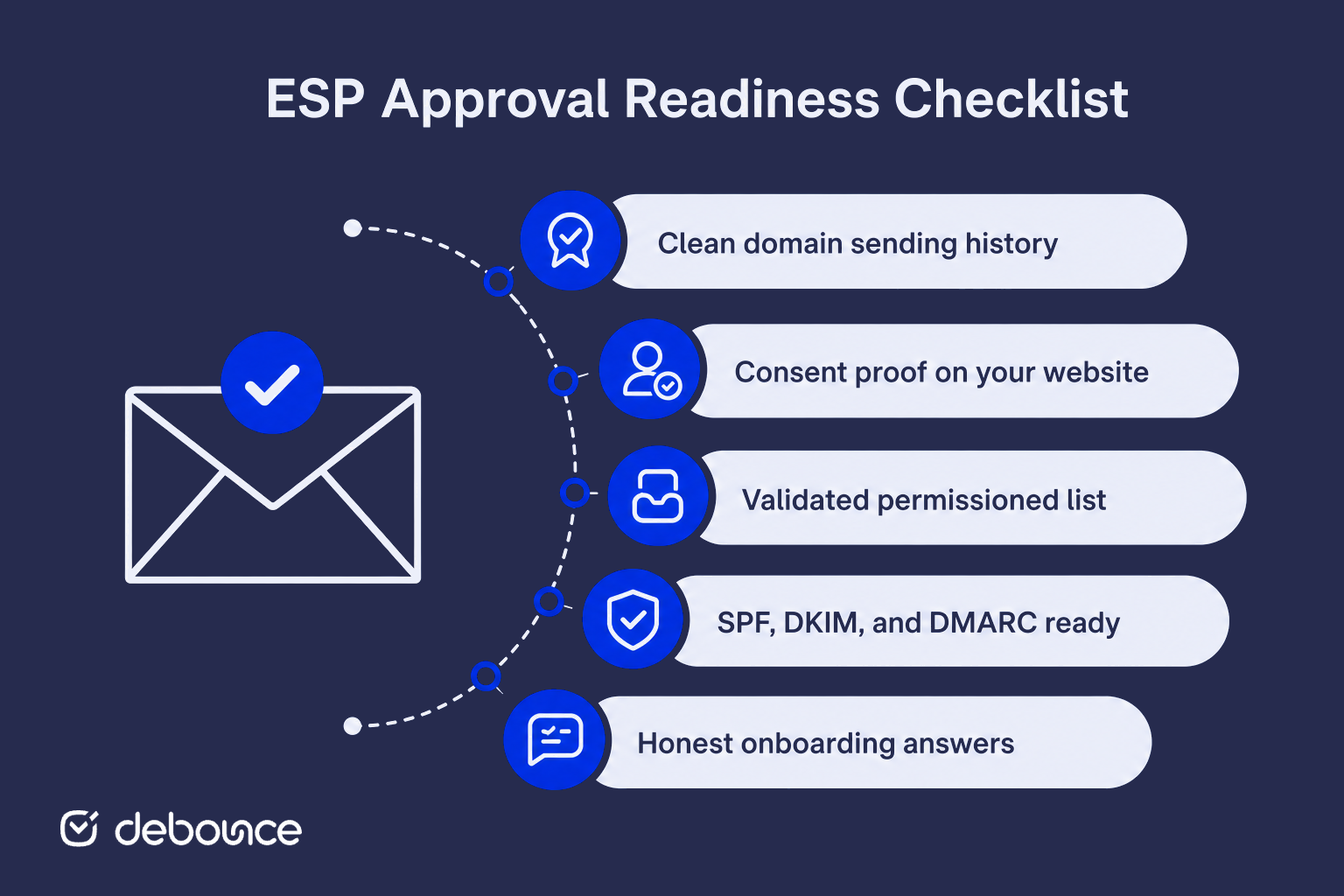
Expect questions like: How many subscribers are on your list? How were they collected? How often do you plan to send? What did you send before? Sample content or subject lines?
Those answers are cross-checked against your website, domain age, DNS authentication posture, and reputation signals. If the story does not add up — a one-month-old domain claiming 100,000 “subscribers” with no visible signup form — approval odds drop fast.
Rejection notes often sound like this: “The account failed proprietary new-account analyses tied to publicly observable domain/DNS and contact signals. Specifics cannot be shared.” Frustrating? Yes. Unusual? No.
Compliance teams compare your words to public evidence. Precision beats marketing language.
Honesty about a past mistake plus a remediation plan is usually safer than hiding purchased data or inflating list quality.
If your domain has a history of unsolicited mail, spam complaints, trap hits, or chronic bounces, automated and human review can decline the account. Purchased or scraped lists are a classic failure mode — even “just once” can leave a mark in public reputation databases. Rebuilding trust is slower than protecting it in the first place. Clean the database before asking an ESP to trust your volume, then run a domain reputation check to spot obvious damage before reapplying.
Reviewers look beyond your sending domain. If your site’s IP (especially on crowded shared hosting) appears on blocklists or sits next to abusive neighbors, that weighs against approval. Fix acquisition quality first — then evaluate whether isolated sending infrastructure makes sense as a next step. A hosting upgrade alone will not clear an ESP review.
Spammers often register fresh domains and start blasting. Compliance teams know the pattern. A domain a few weeks old claiming thousands of marketing subscribers — with thin site content and no visible opt-in — looks like that pattern. Build legitimate presence first: real content, working signup flows, transactional mail history, and gradual list growth. Reapply after the story is credible.
ESPs check whether your site can plausibly explain the list. They look for clear signup forms, consent language that matches what you plan to send, a real privacy policy, and ideally confirmed opt-in for marketing lists. If you claim a large permissioned audience but the site has no capture path, reviewers assume purchased or scraped data. Fix the website before the next application. For consent framing, see GDPR email marketing basics.
Many healthy brands send transactional mail first — receipts, password resets, onboarding — then expand into newsletters. A domain with almost no authentic mail history that immediately wants high-volume marketing access raises flags. Build reputation with real, wanted messages first. Do not invent engagement theater; mailbox providers and ESPs both watch complaint and bounce outcomes.
Some niches face stricter review: aggressive affiliate offers, certain financial or health claims, phishing-style templates, or past policy violations. Even legitimate businesses in sensitive categories need stronger proof of consent, real branding, and verified list quality. Read the ESP’s acceptable use policy before you apply — if your business model conflicts with it, no amount of list cleaning will fix the mismatch. Choose a provider whose terms fit your use case.
Not every rejection comes from intentional abuse. Several normal growth patterns can look identical to purchased-list behavior:
If your list has gone quiet for more than a few months, do not blast everyone. Suppress long-term non-openers, validate the remaining file, and re-engage a warm segment first. A smaller trusted list is easier to approve — and safer to keep approved.
Transactional messages (receipts, password resets, shipping updates) have high engagement and low complaint rates because the recipient just took an action. Marketing and cold outreach carry more bounce and complaint risk. Mixing them in one account means a bad marketing campaign can disrupt your product email.
Whenever possible, use separate sending domains or subdomains for transactional vs. marketing mail, validate outreach lists before any batch send, and monitor bounce and complaint rates with alerts before the ESP has to intervene. Many “overnight bans” start when marketing risk contaminates the account that powers essential product email.
Timeline varies. Simple list-cleanup issues may clear in weeks; serious spam history can take months of clean, authenticated sending. There is no honest “guaranteed approval” shortcut.
Adapt this when a provider asks for clarification or when you reapply after remediation:
Hi compliance team — I understand the previous application was declined. Since then I have validated the contact list with a third-party verification service and reduced it from [X] to [Y] permissioned, safe-to-send addresses. Invalid, disposable, and high-risk contacts were removed. SPF, DKIM, and DMARC are configured for [sending domain]. Contacts were collected via [specific forms/checkout/events], and sample campaign content is attached. I plan to start with engaged segments only and increase volume gradually while monitoring bounce and complaint rates. Happy to provide any additional documentation.
Concrete actions beat vague promises.
Getting approved is only half the job. Most platforms watch early campaigns closely. Common industry guardrails (exact thresholds vary by provider):
Practical habits that protect your standing:
If you are suspended later, read the notice carefully, clean and validate the list before you appeal, fix any authentication gaps, and restart from a small engaged segment. Panic-importing the same dirty file into a second ESP repeats the cycle.
ESP rejections protect shared deliverability — they are a system protecting every legitimate sender on the platform, including you. The path through them is the same whether you are applying for the first time or recovering from a decline: clean lists, permissioned growth, solid authentication, and a consistent story between your answers and your website.
Fix those fundamentals first, then reapply to one provider at a time. If list quality is part of the gap, validate with DeBounce before the next ESP review — bulk cleaning, real-time validation at capture, and list monitoring so reviewers see the cleanest version of your audience.
Common questions about ESP account rejections and how to prepare for approval.
Most providers use proprietary risk checks on domain, DNS, list, and public reputation signals. They keep details vague so bad actors cannot reverse-engineer the review. A short decline email is common even for borderline cases.
No. It usually means that provider will not onboard you in your current state. After you fix list quality, consent proof, and reputation issues, you can often reapply — sometimes after a waiting period.
Damaged domain or IP reputation, purchased or scraped lists, brand-new domains with large unexplained audiences, missing signup/consent evidence on the website, dirty lists full of invalids or trap risk, and inconsistent onboarding answers.
Usually not. Many ESPs evaluate similar risk factors. Fix hygiene and reputation first; otherwise you may collect multiple declines with the same underlying problem.
Validation removes invalid, disposable, and many high-risk addresses before import, which lowers predicted bounce and abuse signals. It does not erase a spammy sending history or replace proof of consent, but it is a core part of a credible remediation plan.
It depends on what failed. Simple list-cleanup issues may be ready in weeks. Serious unsolicited-mail history can take months of clean, authenticated sending and documented permission-based growth. Reapply when your website story and metrics support the answers you will give.
Find quick answers to your questions about our pricing and plans.
A healthy email unsubscribe rate is below 0.5% per campaign; above 1% is a consistent red flag worth investigating across content, frequency, and...

HTML5 is the latest markup language for presenting and structuring content on the internet. HTML stands for Hyper Text Markup Language. It is the standard...


Want your email address to look professional? Worried you used "[email protected]" instead of "[email protected]" and now you're locked out of something important? TLDR: Email addresses...

Domain reputation is a trust score that decides whether your emails reach the inbox or get filtered to spam. Monitoring domain reputation requires...
Spam trigger words raise filter scores when stacked together, written in all caps, or placed in subject lines that don't match the email...
When cleaning up your email, remove promotional emails, old newsletters, and spam in bulk rather than one by one. Clean your primary work...
