
Accept-all (catch-all) and unknown are not the same as valid. They mean the check could not prove the mailbox is real — treat...

Key Takeaways
Every email address you send to is either helping or hurting you. Valid, engaged contacts build reputation and drive revenue. Invalid, stale, and risky ones inflate bounces, distort metrics, and quietly erode your ability to reach the inbox.
That is why email list hygiene is one of the highest-leverage habits in deliverability. It does not replace permission or authentication — but it removes technical risk on the addresses you already have, so your sending efforts actually land.
Here is what a clean list means, why it matters, and how to maintain one.
A clean list is not “every address marked valid forever.” It is a list where invalid and disposable addresses are blocked at capture, risky results like accept-all and unknown follow a clear policy, long-inactive contacts are suppressed or re-permissioned, and you re-verify on a schedule instead of trusting an old export.
Permission and list quality are separate concerns. Cleaning a purchased or scraped list does not create consent. For the tactical side, see how to clean an email list.
Even a carefully built audience drifts. People change jobs, switch providers, abandon inboxes, and mistype addresses at signup. Industry estimates put annual decay around 20–25% — meaning roughly one in five addresses you have today is unreliable within a year. B2B lists decay faster when roles turn over.
Decay shows up as hard bounces, persistent soft bounces, disposable addresses that never converted, catch-all results that stay uncertain, and silent non-engagers who still count toward your list size but never open. If you cleaned once at launch and never again, you are almost certainly sending to invisible risk.
The most direct benefit is fewer hard bounces. Typos, closed mailboxes, and fake signups are common causes of elevated bounce rates — and many ESPs flag sustained rates above 2–5% as a warning sign. Cleaning before a send removes addresses that would fail on contact. Hard bounces should leave your sendable pool immediately; soft bounces that repeat should follow after a short retry window. For thresholds and definitions, see ideal email campaign bounce rate.
Most platforms bill by contact count or send volume. If 10–20% of your list is undeliverable or disengaged dead weight, you are paying for noise on every campaign. Removing those rows cuts cost immediately — and the savings compound when you also stop spending enrichment budget and SDR time on addresses that were never reachable.
An undeliverable address never opens, clicks, or converts — but it still counts in your denominator. That dilutes open rates, click rates, and revenue-per-send in ways that make good creative look weak and bad decisions look reasonable. After you remove invalid rows, your metrics finally reflect how real subscribers actually respond, which makes testing and optimization worth doing.
Once invalid and disposable noise is gone, inactive-vs-active segmentation becomes meaningful. You can see which segments are cooling off, which content resonates, and where a re-engagement campaign or sunset policy is actually needed — instead of guessing against a distorted baseline.
Bad addresses waste SDR and marketing cycles. After a clean, you can segment genuinely engaged contacts away from stale or uncertain ones and put your best offers in front of people who can actually receive them. Sales teams feel this especially — sequences that keep bouncing and “leads” that were never deliverable are a quiet drain on pipeline.
A bad address cannot convert. Cleaning does not raise conversion rates by magic — but it stops you from optimizing against an audience full of people who will never see the message. When your metrics are based on reachable, opted-in subscribers, conversion decisions are based on reality.
ROI improves when you stop funding undeliverable sends, avoid bounce-driven reputation hits, and trust your data enough to make better decisions. Think in cost-per-real-reader and revenue-per-reachable-subscriber, not raw list size. A smaller clean list typically outperforms a larger dirty one.
Chronic bounces, spam traps, and low engagement push mail toward the spam folder — where revenue does not happen. A clean list supports better inbox placement by removing the signals that hurt your sender score. Pair hygiene with solid authentication and quality content; list cleaning alone is not a full deliverability strategy. For reputation context, see how to check email domain reputation.
Mailbox providers weigh bounces, complaints, spam-trap hits, and engagement signals together. Regular validation helps you avoid repeatedly hitting dead or risky addresses, which is one of the most consistent ways to keep those signals healthy. It does not guarantee inbox placement — prevention through permission-based acquisition still comes first. Related: how validation helps reduce spam-trap risk.
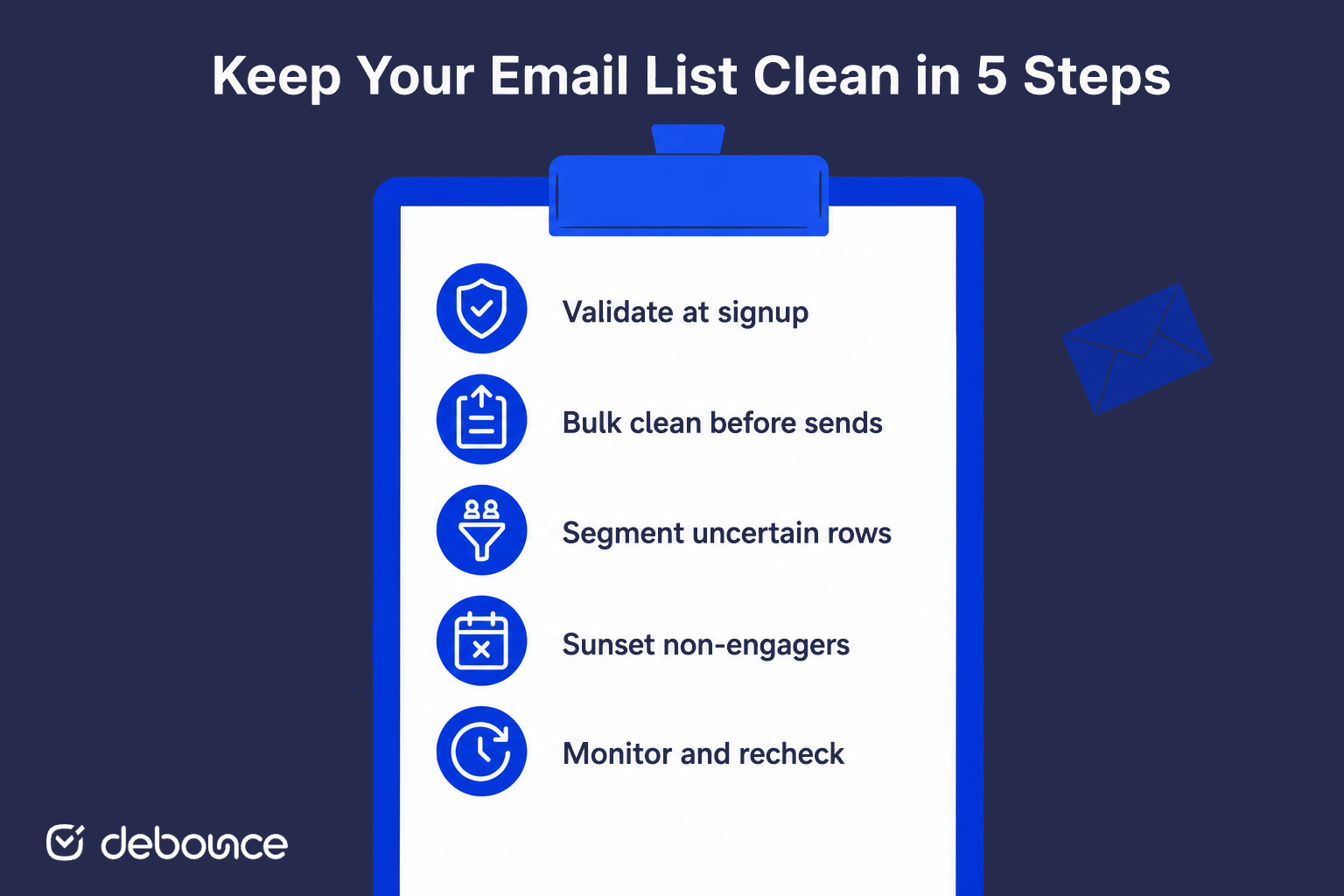
It is much easier to maintain a healthy list than to recover from ESP blocks, throttling, or compliance holds. The practical stack that prevents escalation: real-time checks at signup so bad addresses never enter your CRM; bulk cleaning before major campaigns and after large imports; ongoing monitoring because mailboxes decay continuously; and a clear policy for accept-all and unknown results rather than leaving them to chance.
Cleaning is technical: remove or block invalid, disposable, and high-risk addresses so you are not sending into dead mailboxes. Scrubbing is behavioral: segment or sunset contacts who can receive mail but have stopped engaging.
You need both. A list of technically valid addresses can still damage reputation if most of them ignore every send. And a highly engaged list will still fail if a growing share of rows bounce. Run validation first, then apply engagement rules to the reachable pool.
Catch-all and unknown addresses fall in the middle — technically they might deliver, but they carry real uncertainty. Treat them as their own segment rather than mixing them into your best sends. For guidance, see keep or delete accept-all emails.
List hygiene is not a one-time event. Clean at these moments:
High-growth programs need more frequent passes than slow, double opt-in lists. The size of your acquisition funnel should drive your cleaning cadence.
Technical cleaning handles invalid addresses. Sunset policy handles the valid-but-silent ones. A simple pattern: define inactivity (no open or click in 90–180 days, tuned to your cadence), move those contacts to a lower-frequency watched segment, run one short re-engagement series, then suppress anyone who still shows no positive signal. Keep a suppression reason so future imports do not undo the work.
Sunset protects reputation from recycled spam traps and chronic low engagement. It is separate from your accept-all/unknown policy — those rows need a validation-based decision, not just a time-based one.
Almost every permission-based program benefits from hygiene, but the payoff is sharpest for:
If your acquisition is high-volume or your CRM is more than a year old without a hygiene pass, treat list cleaning as infrastructure — not a pre-campaign checklist item. DeBounce covers the technical layers — bulk validation, real-time API and widget, list monitoring, and catch-all resolution — so your keep/suppress decisions are based on the clearest signals possible rather than guesswork.
These two approaches are complementary, not competing.
Real-time validation runs at the moment of capture — on signup forms, lead flows, or API imports. It blocks invalid, disposable, and role addresses before they ever enter your CRM or ESP. This prevents the problem upstream and means your list quality starts high from day one. The tradeoff is that it only covers new entrants; it does not retroactively fix what is already in your database.
Bulk cleaning runs against your existing list on a schedule or before major campaigns. It catches decay that has accumulated since the last check — closed mailboxes, abandoned inboxes, and domain expirations that happened after addresses were collected. The tradeoff is that it is periodic, so there will always be some lag between when an address goes bad and when you find it.
A complete hygiene program uses both: real-time at the door to maintain baseline quality, bulk passes to clean up historical drift and prepare for high-stakes sends.
Before you clean, snapshot your baselines: hard bounce rate, complaint rate, open and click rates, and inbox placement if your ESP exposes it. After the clean, compare the same metrics on your next campaign. The numbers usually shift within one or two sends — bounce rate drops first, engagement often improves within a few weeks as your sender score recovers.
For a sharper read, segment your cleaned audience and compare it against a held-out dirty segment for one campaign (carefully, and only if you can absorb the reputation risk on the dirty side). That gives you actual evidence of what hygiene is worth — not just a smaller list number.
A clean email list lowers bounce risk, sharpens metrics, protects sender reputation, and makes ROI measurement honest. The routine is straightforward: validate at capture, run bulk cleans before major sends, scrub non-engagers with a sunset policy, and monitor over time. Then send to people who can actually receive your mail — and chose to.
Ready to check your list quality? Start with DeBounce — bulk validation, real-time API/widget, list monitoring, and catch-all tools for uncertain results.
Email list cleaning (validation) checks addresses for deliverability risk — invalid mailboxes, disposables, typos, and other problem patterns — so you can remove or suppress them before sending. It improves list quality; it does not replace consent or guarantee inbox placement.
At minimum before major campaigns and after large imports. Many teams also validate at signup in real time and run quarterly or twice-yearly bulk cleans plus monitoring, because lists decay as people change jobs and abandon inboxes.
There is no universal cutoff, but sustained hard-bounce rates in the low single digits (often cited around 2–5% depending on ESP and send type) are a warning. Rising bounces after an import or cold send are a strong signal to validate before the next campaign.
Cleaning reduces bounce and trap-related risk, which supports sender reputation. Deliverability also depends on authentication (SPF/DKIM/DMARC), engagement, content, and permission. Treat validation as one pillar, not the whole strategy.
Usually yes for marketing performance. Undeliverable and disengaged contacts inflate costs, distort metrics, and can hurt reputation. A smaller audience of real, reachable subscribers typically produces clearer ROI.
Cleaning is technical: remove invalid and high-risk addresses. Scrubbing is engagement hygiene: re-engage or sunset contacts who can receive mail but no longer open or click. Healthy programs do both.
Find quick answers to your questions about our pricing and plans.
Accept-all (catch-all) and unknown are not the same as valid. They mean the check could not prove the mailbox is real — treat...

Enterprise platforms protect against advanced persistent threats and BEC, privacy providers focus on encryption, and hygiene services prevent delivery failures and list contamination....
Spam trigger words raise filter scores when stacked together, written in all caps, or placed in subject lines that don't match the email...

Sometimes, even a small thing, like a dash in your email, can make a huge difference. If you’re looking for answers regarding using a minus,...

Over time, we have seen more people channeling their marketing messages into Gmail’s Primary Tab instead of the newer Promotions Tab. Why this preference? Let’s...

Email analytics is important. It lets you in on a lot of information about your subscribers and their behavior towards your emails. In this post,...
